When NOT to buy intelligence tooling
Guide · Market Growth · 4 min read · last verified 2026-08-11
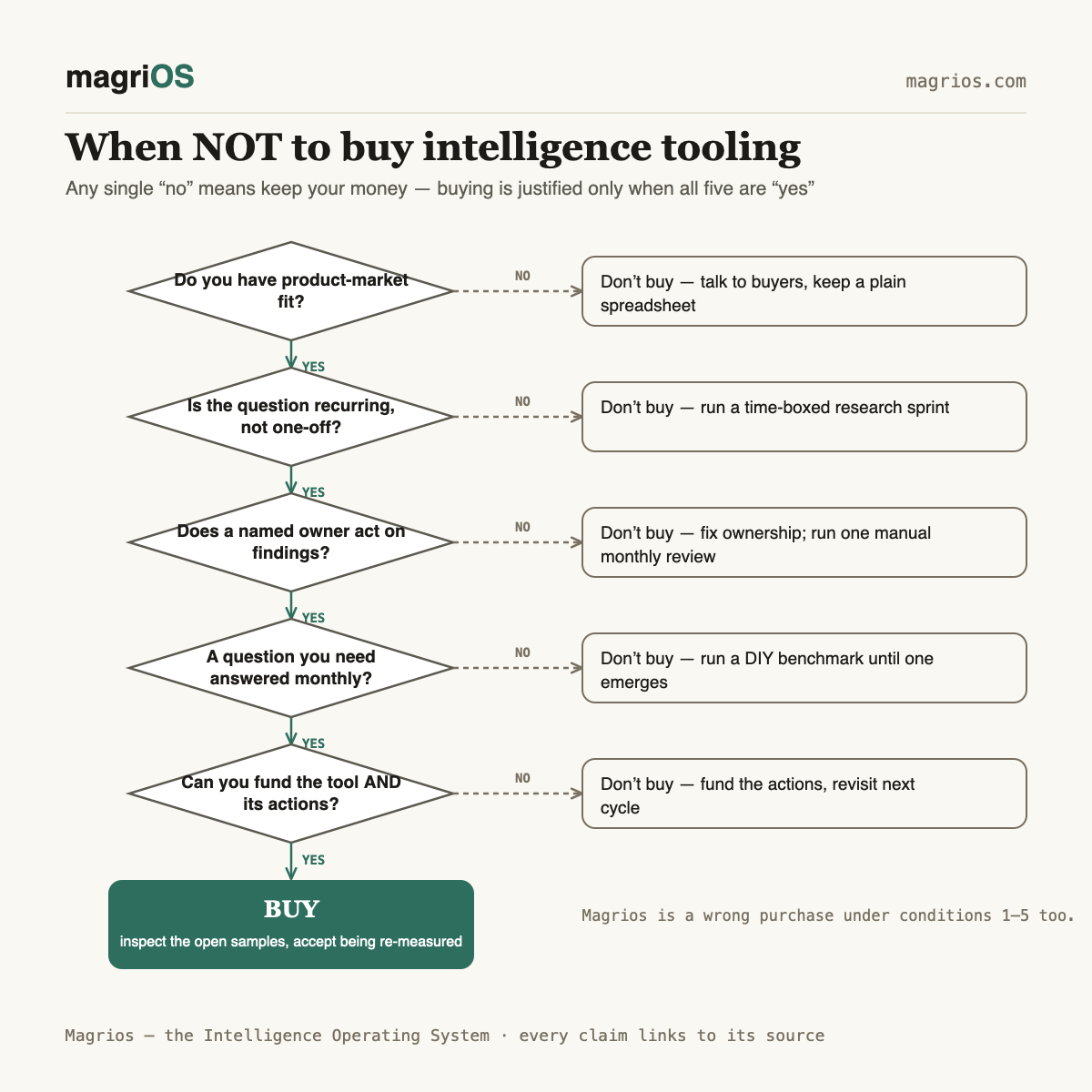
Most companies below a certain level of operational maturity should not buy market intelligence tooling — and this is not reverse psychology from a vendor, it is how the economics of these tools actually work. Intelligence tooling creates value only when three things already exist: recurring questions the team needs answered, a named owner who acts on the answers, and enough capacity to execute what the findings recommend. Absent any one of these, a subscription produces reading rather than decisions, and the honest advice is to keep your money.
The five don't-buy conditions
If any of the following describes your company today, do not buy — not from us, not from anyone.
1. You are pre-product-market-fit. Before product-market fit, the questions that matter are answered by talking to users and shipping, not by monitoring a market you have not yet earned a position in. Competitive intelligence about a category you may pivot out of next quarter is trivia with a subscription fee.
2. You face a single, one-off decision. Entering one market, pricing one launch, evaluating one partnership — these are studies, not subscriptions. A tool built for continuous monitoring is the wrong shape for a question you will ask once. Commission or run a bounded research sprint and be done.
3. Nobody owns acting on findings. If you cannot name the person whose work changes when the tool surfaces something, the findings will be read, nodded at, and archived. Tooling amplifies an ownership structure; it cannot create one.
4. The team cannot name a question it needs answered monthly. "Stay on top of the market" is not a question. If no one can state what they would ask the tool every month — which competitors moved, where our visibility shifted, which buyer questions we lost — the tool has no job, and software without a job is pure cost.
5. The budget would cannibalize the actions the tool recommends. Intelligence tooling tells you what to do; it does not do it. If the subscription consumes the budget that would have funded the content, product, or outreach the findings point to, you have bought a map with the money you needed for the journey.
What to do instead
Each condition has a cheaper, better-fitting remedy. Pre-product-market-fit: talk to buyers directly and keep a plain spreadsheet of what recurs. One-off decision: run a time-boxed research sprint — a bounded week of structured desk research answers most single questions well enough, and Is AI visibility monitoring worth it? walks through how to reason honestly about whether your case is really recurring. No owner: fix that first — assign the role, run one manual monthly review, and only then ask whether tooling would make that person faster. No monthly question: run a DIY benchmark — put the questions your buyers ask to the chat assistants they use, record what comes back in a spreadsheet, and see whether the exercise generates a question you want repeated. Budget conflict: fund the actions now and revisit tooling next cycle.
Deep dive: the total cost nobody prices — attention
The subscription fee is the visible cost. The invisible one is that every feed, alert, and dashboard a tool emits bills your team in reading time, and that bill scales with the tool's output volume, not with your decision volume. This is the mechanic that quietly sinks most intelligence purchases. A tool tuned to demonstrate activity sends more alerts than any team can act on; each alert must be triaged by a person; triage displaces the deep work the tool was meant to inform. The arithmetic is structural even without numbers: if output grows while acted-on findings stay flat, the cost per decision rises every month you keep reading. So the test to run before buying is not "what does this tool show us?" but "what does this tool let us stop reading?" Tools that produce decisions compress the market into a small set of claims with evidence attached, so one owner can act without maintaining a reading habit. Tools that produce reading forward the market to you and call the forwarding insight. Before you shortlist anything — including the category surveyed in What are the best AI visibility monitoring tools — price the attention line first, because it is the cost that compounds.
The buy conditions, stated strictly
Buy when all three hold, and not before. First, you have recurring questions: the same questions, asked on a cadence, where a fresh answer changes what someone does that month. Second, a named owner turns answers into actions and is accountable for doing so. Third, you are willing to be re-measured — to let the same instrument check later whether the actions moved anything, even when the news is unflattering. If all three hold, compare vendors properly — What is the best continuous market intelligence software sets out the evaluation criteria — and hold every candidate, including us, to the attention test above.
Equal candour: when Magrios is the wrong purchase
Magrios is also a wrong purchase under conditions one through five. It is built for teams with recurring visibility questions and an owner who ships fixes; sold to a pre-product-market-fit startup or an ownerless team, it would produce the same unread dashboards as anything else, and we would rather lose that sale than gain a customer who churns disappointed. That is why the free entry points exist: the discovery step and the open sample reports let you see the questions buyers ask in your category and inspect real output before paying anything. Verify that the findings would change what you do next month. If they would not, keep your money — that is this guide working as intended, not its failure case.