Static market reports vs continuous intelligence
Comparison · Continuous Intelligence · 6 min read · last verified 2026-08-11
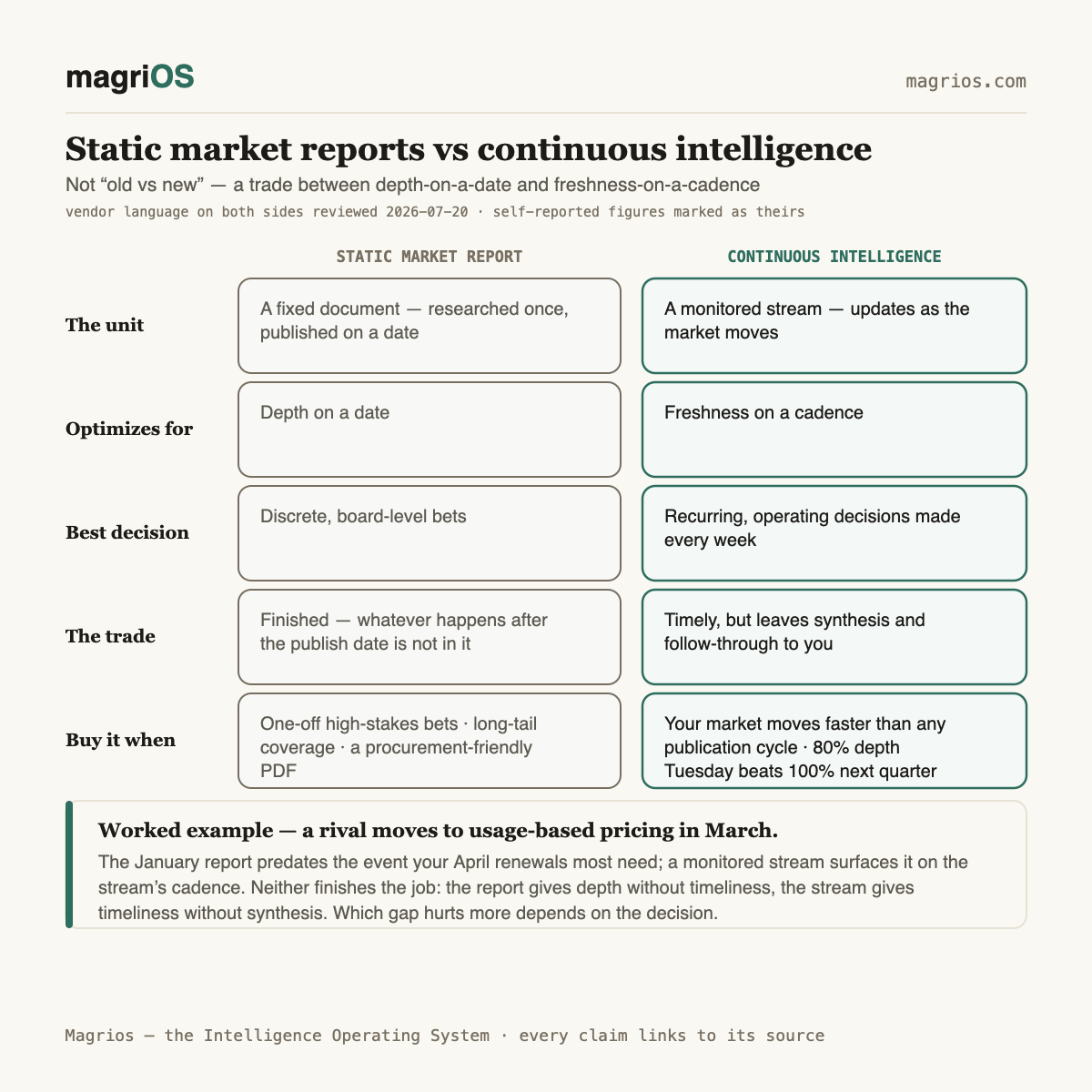
Static market reports deliver a fixed document: researched once, published on a date, and aging from the moment it ships. Continuous intelligence delivers a monitored stream that updates as the market moves. The two formats optimize for different decisions — reports for discrete, board-level bets; continuous intelligence for the operating decisions a team makes every week.
Both formats are real businesses with real buyers, and the honest comparison is not "old vs new" — it is a trade between depth-on-a-date and freshness-on-a-cadence. Every vendor claim below is attributed to the page it came from, all reviewed on 2026-07-20.
What a static market report is built to do
The report publishers describe their product in units of documents. Mordor Intelligence's homepage cites "29107 reports" and states that "17,000+ reports cover more than 20 industry verticals," alongside custom research from "a dedicated team of highly talented analysts" (mordorintelligence.com, accessed 2026-07-20; figures self-reported). MarketsandMarkets, which describes itself as a "Revenue Impact & Advisory Company," leads its primary navigation with "Market Research Reports" (marketsandmarkets.com, accessed 2026-07-20).
That is not an accident of web design — it is a deliberate format. A syndicated report takes a bounded question, researches it deeply, and answers it in a document you can circulate, cite in a board deck, or attach to an investment memo. The publisher's catalog is the product: thousands of pre-answered questions, available the day you need them.
The trade-off is baked into the format. A report is finished. Whatever happens in your market after the publication date is, by definition, not in it. That aging cost is the whole subject of the cost of stale market knowledge, so here we will only note that it is a property of the format, not a failing of any particular publisher.
What continuous intelligence looks like on vendors' own pages
The continuous camp describes its product in units of streams and cadences. HG Insights contrasts its "continuous refresh cadence" with static enrichment and states flatly that "static databases of company records are not market intelligence" (hginsights.com blog, accessed 2026-07-20). Contify positions an "AI-native market and competitive intelligence (M&CI) platform" delivering newsfeeds, sales battlecards, and insights "delivered to every stakeholder in the format they need" (contify.com, accessed 2026-07-20). Valona Intelligence describes "customizable dashboards and reports" plus "Alerts & Newsletters" drawing on a claimed "200K business relevant sources covering all languages" (valonaintelligence.com, accessed 2026-07-20; source count self-reported).
One thing this article will not pretend: continuous intelligence is not an empty field waiting for a challenger. ZoomInfo markets workflows "triggered by buying signals" with "real-time alerts" (pipeline.zoominfo.com, accessed 2026-07-20), and nRev sells signal-driven playbooks routed into Slack and CRM (nrev.ai, accessed 2026-07-20). The continuous, action-oriented position is occupied by incumbents saying it in their own words — a fuller map of that segment is in buying-signal workflows explained. For a definition-level treatment of the category itself, see what is continuous market intelligence.
The report publishers are converging on continuous too
The line between camps is blurring from the report side as well. MarketsandMarkets now markets "GrowthIQ — AI-Powered Strategic Intelligence," promising "From Research to Strategy in Minutes" and "board-ready outputs with 15+ consulting-grade strategy documents," alongside a subscription platform (KnowledgeStore) and an AI sales product, SalesPlay (marketsandmarkets.com, accessed 2026-07-20; all claims theirs).
Whether GrowthIQ's output is operational tooling or a faster-generated document is not determinable from the public page — we flag that as unverified rather than guessing. But the claimed direction matters: even the report houses are marketing speed-to-strategy, not shelf life. The format war is being conceded in the incumbents' own copy.
Worked example: one pricing change, two formats
Worked example. Suppose your closest competitor moves to usage-based pricing in March.
- Static path: the syndicated report on your category that shipped in January describes the competitor's old pricing model. The change appears in the next edition, whenever that is scheduled. If your renewal conversations run in April and May, the document informing them predates the event it most needed to contain.
- Continuous path: a monitored stream — a Contify-style newsfeed, a Valona-style alert, a ZoomInfo-style signal trigger, in each vendor's own framing — surfaces the change on the cadence of the stream, and the open question becomes what your team does with the alert, not whether it arrived.
Neither path finishes the job by itself. The report gives you depth without timeliness; the stream gives you timeliness and leaves synthesis and follow-through to you. Which gap hurts more depends on the decision at hand — the recurring version of this problem is covered in why quarterly market reviews miss shifts.
When a static report is the better buy
Unhedged, because a comparison that never concedes anything is marketing wearing a lab coat:
- One-off, high-stakes bets. For a market entry, an acquisition, or a board-level TAM question, a document with a named methodology and accountable human analysts is the right artifact. Mordor sells exactly that — "a dedicated team of highly talented analysts" for tailor-made work — and Evalueserve markets "domain expert recommendations" (both pages accessed 2026-07-20, claims theirs).
- Long-tail coverage. A catalog the size Mordor claims answers obscure questions immediately. If your question is "the market for industrial adhesives in Southeast Asia," a report house very likely has a document; a monitoring product tuned to your niche very likely does not.
- Procurement-friendly deliverables. A fixed-scope PDF with a fixed invoice is easy to buy, easy to file, easy to defend.
If those describe your situation, buy the report. It is the better instrument for that job.
When continuous intelligence is the better buy
- Your market moves faster than any publication cycle — competitor pricing, positioning, hiring, and launches shift monthly, and decisions ride on them.
- Your decisions are recurring and operational: renewal talking points, battlecard updates, campaign timing — not one-time bets.
- You would rather have 80% depth on Tuesday than 100% depth next quarter, because the decision is on Wednesday.
(Disclosure: Magrios, which publishes this blog, sells a continuous market-intelligence product aimed at small teams — read this section knowing we have a side.)
Questions to ask before you pick a format
- Is the decision discrete (one bet) or recurring (an operating cadence)?
- What is the half-life of the facts involved? Pricing and positioning decay in weeks; market-size estimates decay in years.
- Who translates the intelligence into action — and does the format hand them a document, an alert, or a drafted next step?
- What does the format assume you already have? Data feeds assume engineering; triggered workflows assume a CRM stack; reports assume reading time. The full map is in the five delivery formats of market intelligence.
- What does it cost? Note that on all 14 vendor pages we reviewed for this series on 2026-07-20, no rate card was published — the pattern is examined in "contact sales" is the price.
Sources and verification
All vendor language quoted above was observed on 2026-07-20 on: mordorintelligence.com (homepage), marketsandmarkets.com (homepage), hginsights.com (market-intelligence tools guide), contify.com (market-intelligence blog), valonaintelligence.com (what-is-market-intelligence whitepaper page), pipeline.zoominfo.com (market-intelligence page), nrev.ai (market-intelligence glossary). Customer counts, report counts, and source counts are the vendors' own self-reported figures and were not independently confirmed. Absence of a feature or claim from a page means only that we did not find it there on that date. Re-verify by 2026-10-18.