The market intelligence action gap: why tools stop right before you act
Guide · Continuous Intelligence · 5 min read · last verified 2026-08-11
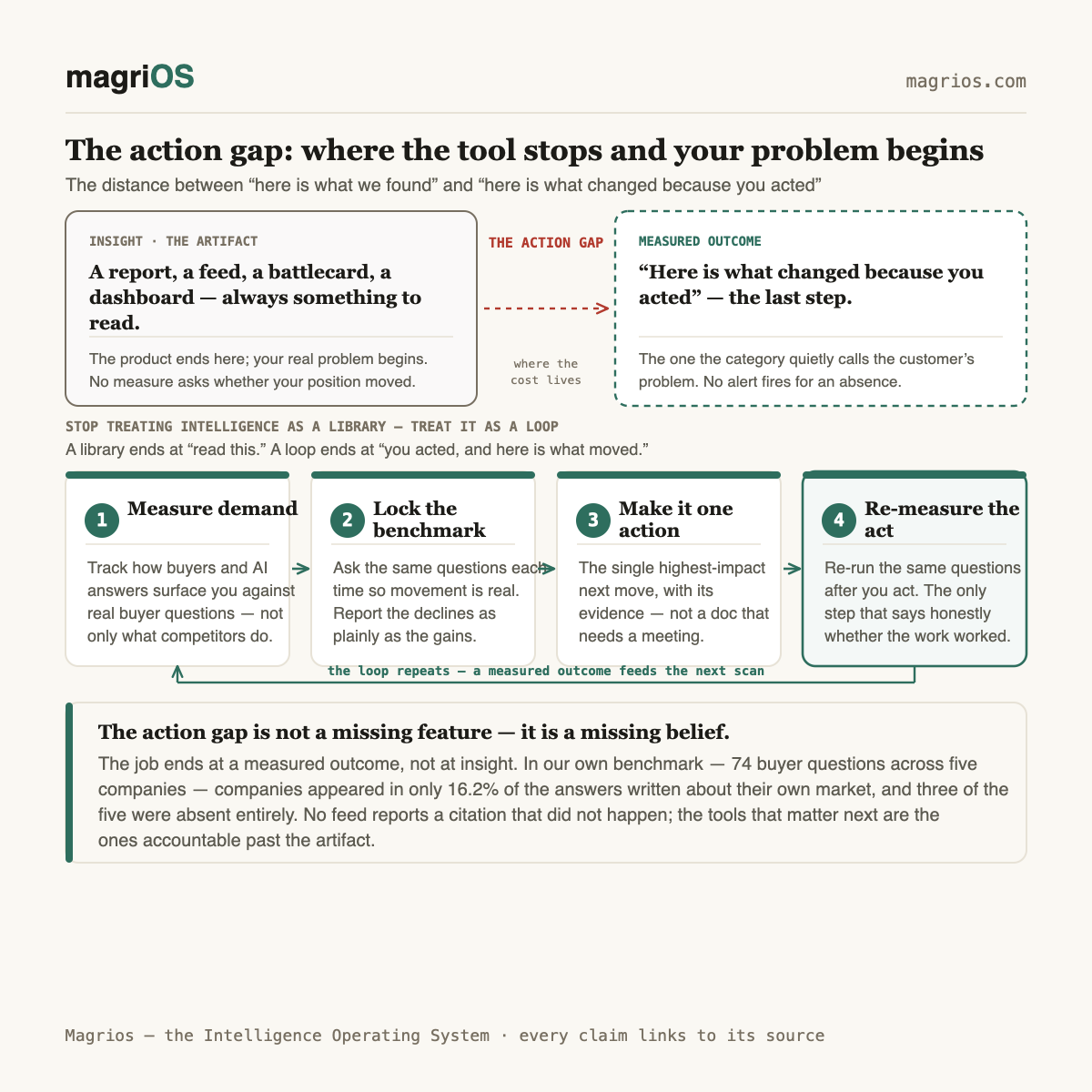
Most market intelligence tools stop working at the exact moment you need them most — the moment you have to decide what to do. They gather signals, summarize them, and hand you an artifact: a report, a feed, a battlecard, a dashboard. There the product ends and your real problem begins. That distance between "here is what we found" and "here is what changed because you acted" is the action gap, and it is the quiet, defining feature of almost every tool in the category.
What exactly is the action gap?
The action gap is the space a tool leaves between insight and outcome. Nearly every intelligence product describes itself as "actionable" or "decision-ready." Read past the adjective to the delivery format and the promise thins out: the thing you actually receive is always something to read. A syndicated report optimizes for board-ready depth and assumes you have the reading time and a discrete decision to make. A monitored newsfeed optimizes for awareness on a cadence and assumes you have a reader who will translate the feed into action. A consulting engagement optimizes for accountability but assumes you have budget, a timeline, and an executive sponsor. Each format is honest about what it does. None of them does the last step — the one where a person turns the intelligence into a change, and then finds out whether the change worked.
That last step is where the cost lives, and it is the step the category has quietly agreed is the customer's problem.
Why does the gap exist at all?
Because the category was built on a premise that was true when it formed: gathering information was the scarce, valuable act. When market signals were scattered across filings, news, review sites, and competitor pages, the hard part — the part worth paying for — was collecting and organizing them. Aggregation was the value. Every operating model in the category is a variation on collect, aggregate, present, and every one of them measures its own activity: sources monitored, mentions captured, reports produced, alerts sent. Those are measures of gathering. None of them measures whether your position in the market actually moved.
The premise made sense. It has simply stopped being true.
What changed?
Two things at once, and they compound.
First, aggregation is commoditizing. A capable language model pointed at public data now reconstructs "monitor these competitors and summarize what is new" cheaply and quickly. The activity that used to justify the category's price is becoming something a small team can approximate on its own. When the gathering is no longer scarce, the value has to move somewhere — and it moves to the two things a model cannot do for you: verify what it found, and act on it in a way you can measure.
Second, buyers moved. They increasingly begin not on your website or a competitor's, but in a search engine or an AI assistant that answers from a specific set of public pages. This is a new discovery layer, and it is the one place almost no incumbent tool looks — they watch what competitors publish far more than how buyers actually find. The blind spot is not small. In our own research — a benchmark across 74 buyer questions for five companies — companies appeared in only 16.2% of the answers written about their own market, and three of the five were absent entirely. A tool can monitor every competitor press release and still never tell you that you are invisible in the place your buyers now start.
What does the action gap cost you?
It costs you the deals you never see. A lost competitive deal at least leaves a trace — a "we went with someone else" email. The deals lost to the action gap leave nothing, because they were never deals: a buyer asked a question, an answer surfaced companies that were not you, and the buyer moved on. No alert fires for an absence. No feed reports a citation that did not happen.
It also costs you time in the most expensive way. The intelligence arrives as an artifact, and then a person has to translate it — into a content brief, an outreach list, a positioning change — and execute, and later try to reconstruct whether any of it worked. That translation is where the consultants, the spreadsheets, and the standing meetings live. The tool billed you to remove work and then handed the hardest work back.
How do you close the action gap?
You stop treating intelligence as a library and start treating it as a loop. A library ends at "read this." A loop ends at "you acted, and here is what moved." Concretely, that means four disciplines the artifact model skips:
- Measure demand, not just supply. Track how buyers and AI answers actually surface you against a set of real buyer questions, not only what competitors are doing.
- Lock the benchmark. Ask the same questions each time so movement is real and comparable, and report the declines as plainly as the gains. A number that only ever rises is a sales instrument, not a measurement.
- Turn the gap into a specific action, not a summary. The output of a scan should be the single highest-impact thing to do next, with the evidence behind it — not a document that needs a meeting to interpret.
- Re-measure the same questions after you act. This is the step that closes the loop, and the only one that tells you honestly whether the work worked.
None of this is exotic. It is simply the part of the job the category decided was someone else's. The tools that matter over the next decade will be the ones accountable past the artifact — the ones that measure whether your company is actually becoming stronger, and can show the evidence for the answer.
The action gap is not a missing feature. It is a missing belief: that a market intelligence tool's job does not end at insight. It ends at a measured outcome.