Buying-signal workflows explained: what ZoomInfo-style activation automates
Guide · Continuous Intelligence · 6 min read · last verified 2026-08-11
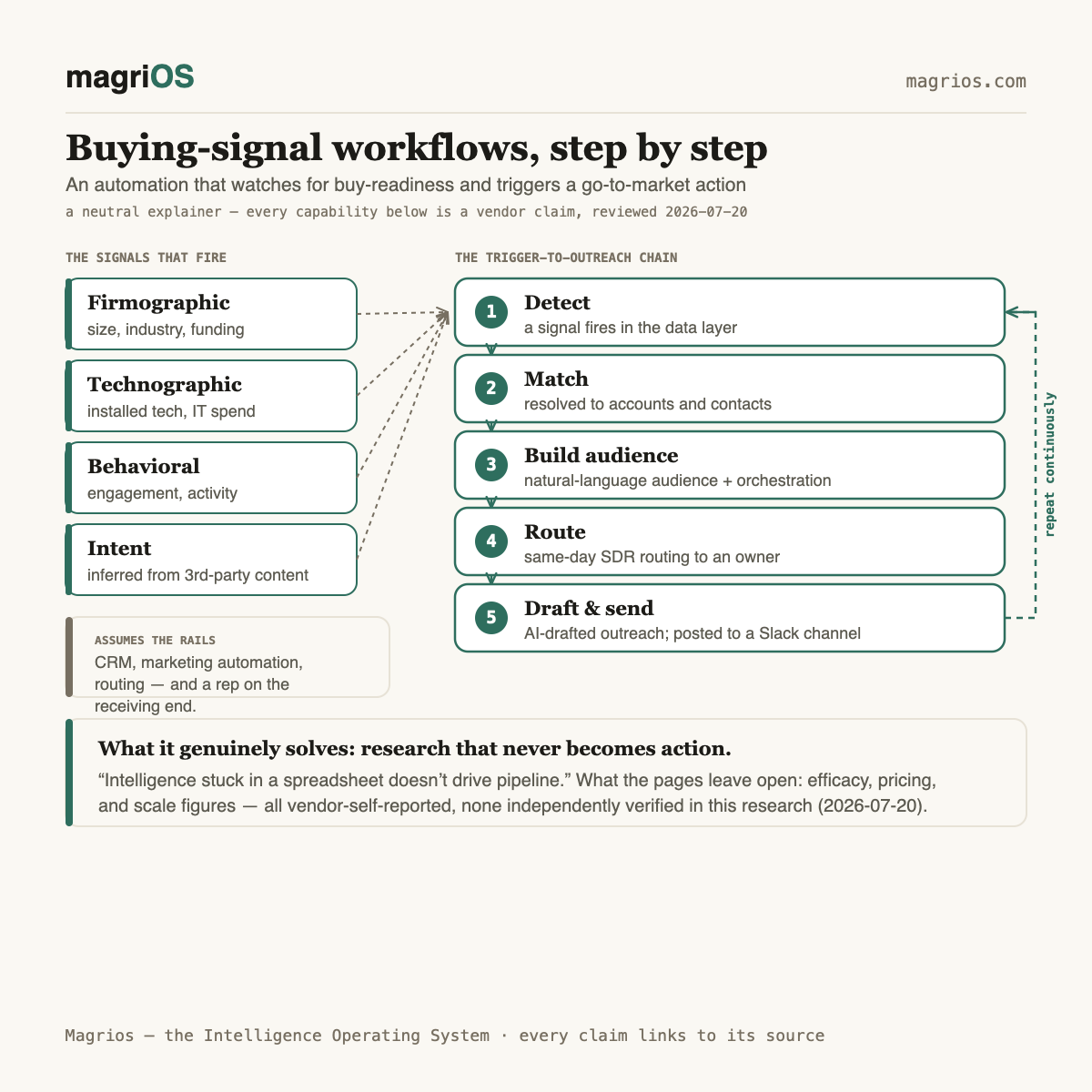
A buying-signal workflow is an automation that watches for indications a company may be ready to buy — funding events, hiring, technology installs, intent data — and triggers a go-to-market action: routing the account to a rep, drafting outreach, launching a sequence. ZoomInfo, HG Insights, and nRev each describe a version of this model on their own pages.
This is a neutral explainer. Everything below is drawn from the three vendors' published descriptions, reviewed on 2026-07-20, with their claims labeled as claims. Where the model is genuinely strong, we say so; where the public record is silent, we say that too.
What counts as a buying signal
ZoomInfo's page describes a "GTM Context Graph" that "processes 1.5B+ data points daily, fusing firmographic, technographic, behavioral, and intent signals" (pipeline.zoominfo.com, accessed 2026-07-20; figures self-reported). Those four adjectives are a workable taxonomy for the whole category:
- Firmographic — what the company is: size, industry, geography, funding.
- Technographic — what it runs: installed technologies, IT spend patterns. HG Insights defines market-intelligence tools as "platforms that combine account-level data – technographics, IT spend signals, buyer intent, and firmographics – with market-level modeling" (hginsights.com, accessed 2026-07-20).
- Behavioral — what its people do: engagement and activity signals.
- Intent — what it appears to be researching, inferred from third-party content consumption.
For the broader concept of signals beyond the sales context, see what is a market signal.
The workflow, step by step, as the vendors describe it
A composite of the three vendors' own descriptions — each step attributed:
- Detect. A signal fires in the vendor's data layer (ZoomInfo: 1.5B+ data points daily; HG: "more than 20 billion market data points" across "over 20 million companies" — both self-reported).
- Match. The signal is resolved to accounts and contacts (ZoomInfo claims 500M contacts, 100M companies — self-reported).
- Build the audience. ZoomInfo's GTM Studio offers "natural language audience building and campaign orchestration" (their description).
- Route. The account reaches an owner — ZoomInfo advertises "same-day SDR routing"; HG describes pushing signals "automatically into routing logic, nurture tracks, and scoring models so intelligence triggers action."
- Draft and execute. ZoomInfo's GTM Workspace couples "prioritized accounts, AI-drafted outreach, and real-time alerts"; nRev's playbooks route outputs "to Slack, CRM, sheets" (all vendor language).
- Repeat continuously. HG contrasts a "continuous refresh cadence" with one-time data enrichment; the paradigm's relationship to always-on monitoring is covered in what is continuous market intelligence.
Three vendors, three emphases
| Vendor | Self-description (2026-07-20) | Emphasis |
|---|---|---|
| ZoomInfo | "The AI GTM platform that turns B2B intelligence into pipeline"; workflows "triggered by buying signals"; APIs and MCP access | End-to-end GTM execution on its own data graph |
| HG Insights | "Revenue Growth Intelligence (RGI) Platform" — market modeling plus account intelligence, buyer intent, and workflow activation; native Salesforce, HubSpot, Marketo integrations; three AI copilots (Market Analyzer, Data Studio, Sales Copilot) | Technographics and IT-spend modeling activated inside an existing CRM stack |
| nRev.ai | Agent-based GTM automation; named playbooks such as Competitor Prospect Tracker and Signal-Based Outbound | Configurable agents executing signal-driven plays into Slack/CRM/sheets |
All three descriptions are the vendors' own; none were independently tested for this article.
What this model genuinely solves
The concession, without hedging: buying-signal activation is a real answer to a real failure mode. The oldest problem in market intelligence is research that never becomes action — the industry's own how-to content repeats the warning constantly, a pattern cataloged in "actionable insights" is the most overused phrase in market intelligence. The activation vendors attack it head-on and say so in plain terms. ZoomInfo: "Intelligence stuck in a spreadsheet doesn't drive pipeline." HG Insights: "Static databases of company records are not market intelligence."
For a sales-led organization with a live CRM stack, the described model — signal in, routed account and drafted outreach out, same day — collapses a handoff chain that otherwise crosses several tools and teams. As a category direction, this is a genuine strength, and it is why the segment's framing has been adopted even by vendors far from the GTM data business.
What the public pages leave open
Three things a buyer should know are not answerable from the vendors' pages alone:
- Efficacy. Whether the activation performs as advertised is not determinable from marketing pages; we collected no third-party evaluations or customer-verified results in this research. Every workflow description above is a vendor claim.
- Pricing. No rate card appeared on the pages reviewed (2026-07-20). ZoomInfo describes being "free to start with consumption credits based on usage" — a model, not a figure. The category-wide pattern is documented in "contact sales" is the price.
- Scale figures and logos. Contact counts, data-point volumes, and case-study names (ZoomInfo's page cites Microsoft, MongoDB, Capital One, monday.com) are self-reported and were not independently confirmed.
What the model assumes you have
The vendors' own integration lists and ICP language define the intended operating environment: a CRM (Salesforce or HubSpot appear by name in HG's integration list), marketing automation (Marketo, nurture tracks), routing and scoring infrastructure, and people — ZoomInfo names SDR routing; nRev names RevOps leaders and GTM operators as its users. A team evaluating this category should read those prerequisites as part of the product: the workflow's destination systems are supplied by the customer. How the model translates — or does not — outside that environment is a separate question, taken up in market intelligence for teams without a RevOps stack.
Worked example: a funding-round signal, end to end
Worked example, composed strictly from the vendors' published descriptions. A target account announces a Series B.
- The funding event enters the data layer as a firmographic signal (ZoomInfo's Context Graph description).
- The account matches an active workflow filter — say, "Series B+, 100–500 employees, runs a competitor's product" (technographic criteria of the kind HG describes).
- The workflow fires: the account is scored, routed to its owner the same day (ZoomInfo's "same-day SDR routing" claim), and outreach is drafted (ZoomInfo's "AI-drafted outreach" claim).
- A parallel play posts the signal to a deal channel (nRev's Slack routing description).
- The rep reviews, edits, sends; the sequence continues in the CRM.
Note what made the example work: filters configured in advance, a CRM to route within, and a rep on the receiving end. The automation, as described, is the connective tissue between data the vendor supplies and systems the customer already runs.
Who this model is built for
In the vendors' own ICP language: B2B sales, marketing, and RevOps teams from mid-market to enterprise (ZoomInfo); sales, marketing, RevOps, and strategy leaders at B2B technology companies (HG Insights); RevOps leaders and GTM operators at B2B SaaS, financial services, and cybersecurity firms (nRev). Buyers matching those descriptions are the audience the workflows were designed around, and for them this category represents the current state of the art in making intelligence operational — as claimed, pending the third-party evidence the public record does not yet supply.
Sources and verification
All vendor descriptions quoted from: pipeline.zoominfo.com/marketing/market-intelligence, hginsights.com (market-intelligence tools guide), nrev.ai/glossary/market-intelligence — accessed 2026-07-20. All data-scale figures, integration claims, workflow capabilities, and customer names are the vendors' self-reported statements and were not independently verified. Re-verify by 2026-10-18.