“Actionable insights” is the most overused phrase in market intelligence
Guide · Continuous Intelligence · 5 min read · last verified 2026-08-11
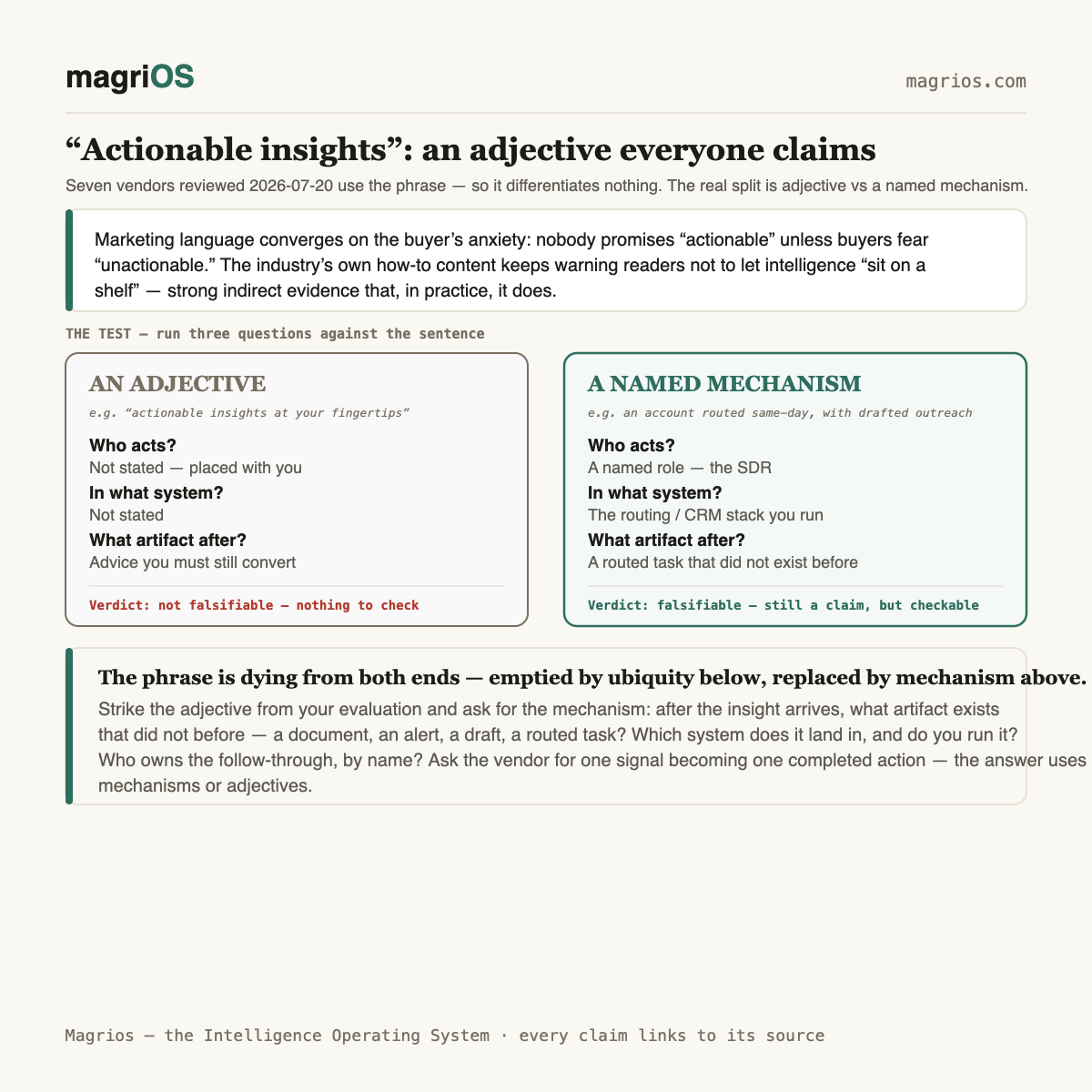
Some form of "actionable insights" language appears on the pages of seven market-intelligence vendors we reviewed on 2026-07-20: Mordor Intelligence, Evalueserve, Contify, Valona Intelligence, Entropik, MarketsandMarkets, and Arfadia. When every vendor claims it, the phrase differentiates nothing. The useful question is what mechanism, if any, sits behind the adjective.
This piece is sourced almost entirely by quotation. Every line below is the vendor's own published language, with the page and date it was observed. Their claims are their claims; we quote, attribute, and let you judge.
The phrase, as seven vendors use it
| Vendor | Their published line | Page (accessed 2026-07-20) |
|---|---|---|
| Mordor Intelligence | "Actionable market insights across geocentric and customer-centric markets." | mordorintelligence.com |
| Evalueserve | "Actionable insights and domain expert recommendations at your fingertips." Also: "Actionable insights proactively for faster decision-making." | evalueserve.com/market-intelligence |
| Contify | Converts "complex market and competitive signals into actionable intelligence"; sells "decision-ready insights." | contify.com |
| Valona Intelligence | "Insights and recommendations that your different business units can actually use." | valonaintelligence.com |
| Entropik | "From Emotion to Action, With Insights That Speak Your Language"; "Put the insights you've gained into action." | entropik.io |
| MarketsandMarkets | "From Research to Strategy in Minutes." | marketsandmarkets.com |
| Arfadia | "GTM intelligence is only useful to the extent that it results in a strategic action, not data." | arfadia.com |
Seven vendors, spanning syndicated research, analyst services, monitoring platforms, consumer research, and an agency's educational content — one adjective. A word this evenly distributed carries no information about which product to buy.
Why the ubiquity is itself the finding
Marketing language converges on the buyer's anxiety. Nobody promises "actionable" unless buyers fear "unactionable" — and the industry's own how-to content says the fear is well founded.
SurveyMonkey's guide to developing market intelligence needs a dedicated step — "Take action on insights" — to tell readers the information they collected "shouldn't sit on a shelf" (surveymonkey.com, accessed 2026-07-20). Pragmatic Institute's market-intelligence primer concedes that "reporting to the executive team that a competitor is gaining market share is only marginally beneficial" (pragmaticinstitute.com, accessed 2026-07-20). nRev's glossary lists "not adapting intelligence findings into practical, actionable strategies" as a common mistake (nrev.ai, accessed 2026-07-20). Arfadia adds that "intelligence that doesn't influence decisions is merely interesting, not valuable" (arfadia.com, accessed 2026-07-20).
Multiple independent vendors and a training company published don't-let-it-sit-on-a-shelf articles in 2025–2026. That is strong indirect evidence that, in practice, it sits on the shelf. An industry that had solved the action problem would not keep writing the same warning. The recurring cost of that shelf is quantified differently in the cost of stale market knowledge.
The vendors that describe a mechanism instead of an adjective
Here is the honest complication: a subset of the market has moved past the adjective to a described mechanism, and they deserve the distinction.
ZoomInfo's market-intelligence page states "Intelligence stuck in a spreadsheet doesn't drive pipeline," and describes workflows "triggered by buying signals," "AI-drafted outreach," and "same-day SDR routing" (pipeline.zoominfo.com, accessed 2026-07-20). HG Insights describes signals pushed "automatically into routing logic, nurture tracks, and scoring models so intelligence triggers action" (hginsights.com, accessed 2026-07-20). nRev describes intelligence as executable playbooks routed into Slack and CRM (nrev.ai, accessed 2026-07-20).
Whatever you think of the claims — and we collected no third-party evidence on whether the activation works as advertised, so they remain claims — these sentences name a mechanism: a trigger, a system, an artifact. That is categorically different from an adjective, and it is why the phrase "actionable insights" is dying from both ends: emptied by ubiquity below, replaced by mechanism language above. The mechanism model is unpacked neutrally in buying-signal workflows explained.
Worked example: testing the phrase on a real sentence
Worked example. Take Evalueserve's line, quoted above: "Actionable insights and domain expert recommendations at your fingertips." Run three questions against it:
- Who acts? Not stated in the line. "At your fingertips" places the action with you.
- In what system? Not stated in the line.
- What artifact exists afterward? A recommendation — which is genuinely more than raw data, and Evalueserve markets an expert-recommendation model — a claim we could not verify from the pages reviewed, and one whose delivery mechanics are not publicly documented. But the artifact is advice, and advice still requires your team to convert it into a sent email, a changed price, an updated battlecard.
Now run ZoomInfo's "same-day SDR routing" through the same test: who acts (an SDR), in what system (their routing/CRM stack, per ZoomInfo's description), what artifact (a routed account with drafted outreach). As a claim, it answers all three on its face. The test does not tell you the claim is true — it tells you the sentence is falsifiable, which "actionable insights" never is.
The questions that replace "is it actionable?"
Strike the adjective from your evaluation and ask for the mechanism:
- After the insight arrives, what artifact exists that did not exist before — a document, an alert, a draft, a routed task?
- Which system does it land in, and do we run that system? (If the answer assumes a CRM and marketing-automation stack you do not have, see market intelligence for teams without a RevOps stack.)
- Who owns the follow-through, by name?
- What is the smallest market change that would trigger something — and what, exactly, gets triggered? A grounding definition helps here: what is a market signal.
- Ask the vendor for a worked example of one signal becoming one completed action. Their answer will use either mechanisms or adjectives.
This is also the standard we try to hold our own copy to at Magrios: if a sentence claims action, it should name the artifact — and you should apply exactly this test to us.
Sources and verification
All quotations were observed on 2026-07-20 on the vendors' own pages: mordorintelligence.com, evalueserve.com/market-intelligence, contify.com, valonaintelligence.com, entropik.io, marketsandmarkets.com, arfadia.com, surveymonkey.com, pragmaticinstitute.com, nrev.ai, pipeline.zoominfo.com, hginsights.com. Quotations are the vendors' marketing language, reproduced for comparison and criticism, and imply nothing beyond what the words say. No claim is made here about any vendor's actual product behavior — only about their published language on that date. Re-verify by 2026-10-18.