The five delivery formats of market intelligence — and what each optimizes for
Guide · Continuous Intelligence · 5 min read · last verified 2026-08-11
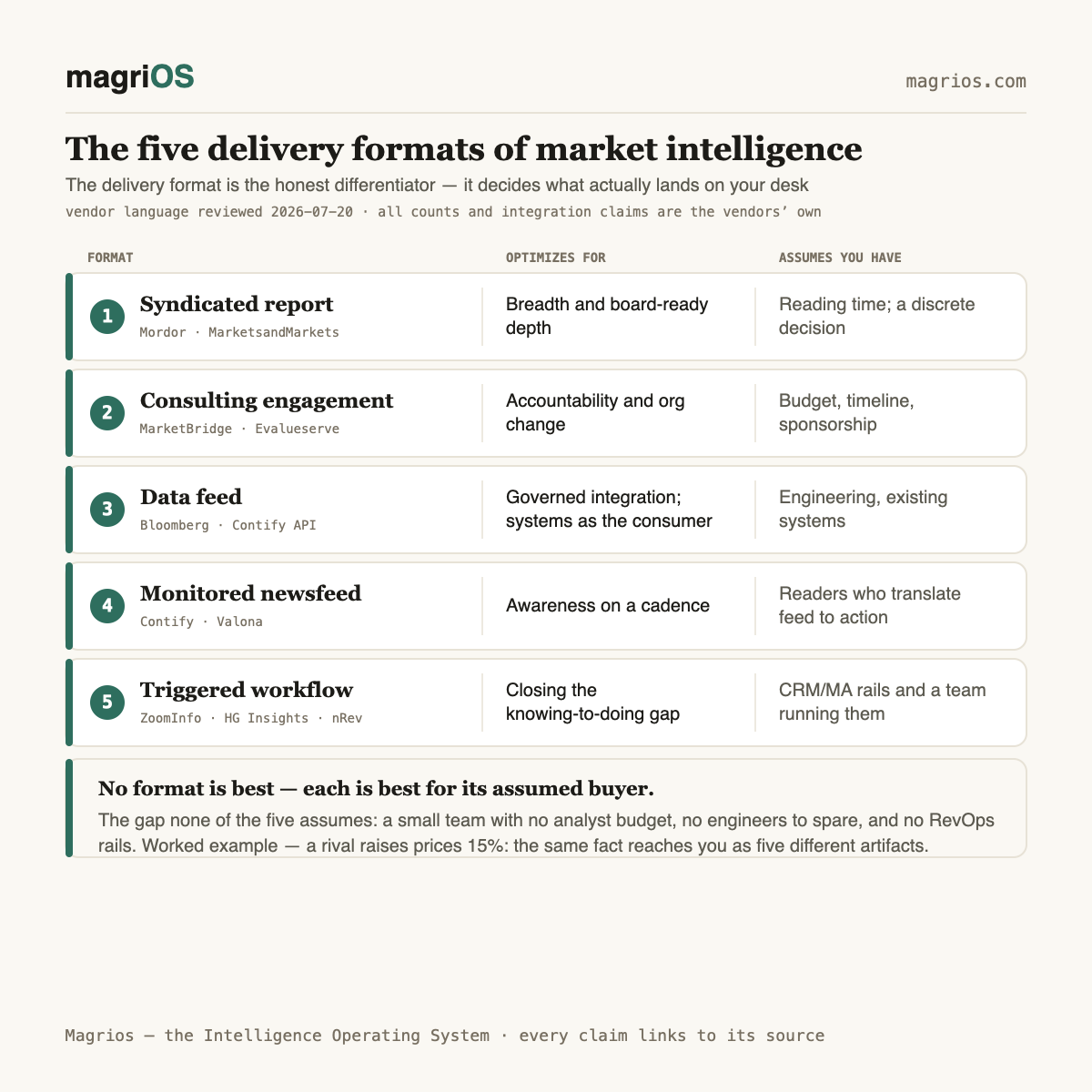
Market intelligence ships in five delivery formats: the syndicated report, the consulting engagement, the data feed, the monitored newsfeed, and the triggered workflow. Each optimizes for a different buyer and decision cadence — and each quietly assumes something about the team and stack on the receiving end.
Vendors rarely frame themselves this way; they frame themselves as "insights." But the delivery format is the honest differentiator, because it determines what actually lands on your desk. Every vendor description below is drawn from the vendor's own page, reviewed on 2026-07-20.
Format 1: The syndicated report
Exemplars, in their own words: Mordor Intelligence's homepage cites "29107 reports," with "17,000+ reports cover[ing] more than 20 industry verticals" (self-reported figures); MarketsandMarkets leads its navigation with "Market Research Reports" and calls itself a "Revenue Impact & Advisory Company."
What it optimizes for: breadth and immediacy of coverage. A large catalog answers a long-tail question — an obscure vertical, a distant geography — the day you ask it. The document format also travels well into board decks and investment memos.
What it assumes about you: reading time, and a decision that is a discrete event. The report is finished on its publication date; the deeper trade is examined in static market reports vs continuous intelligence.
Format 2: The consulting engagement
Exemplars: MarketBridge describes its Growth Intelligence model as a phased engagement that "ASSESSES data, technology and organizational readiness … ESTABLISHES the cloud data foundation … BUILDS the full GTM data layer … ACTIVATES intelligence across marketing, sales and growth workflows … CONTINUOUSLY OPTIMIZES," and is explicit that it is "not just a CDP" (marketbridge.com). Evalueserve markets "actionable insights and domain expert recommendations at your fingertips" (evalueserve.com); Mordor sells custom research from "a dedicated team of highly talented analysts."
What it optimizes for: accountability and organizational fit. Humans study your specific situation and stand behind the recommendation. For fragmented enterprise stacks — MarketBridge's stated target is organizations with "fragmented data & knowledge assets" — a phased engagement is often the only format that can even begin.
What it assumes about you: budget for a services engagement, a timeline measured in phases, and executive sponsorship to carry it.
Format 3: The data feed
Exemplars: Bloomberg's enterprise data page promises "high-quality data that seamlessly integrates into the tools your firm uses to make critical decisions," organized under four pillars — "Comprehensive," "Integrated," "Controlled," "Networked" — delivered via the Terminal, APIs, and real-time feeds (professional.bloomberg.com). Contify offers a "Business News API" providing "structured business news data via APIs" (contify.com).
What it optimizes for: systems as the consumer. A feed is intelligence as infrastructure: governed, integrated, machine-readable.
What it assumes about you: engineering capacity and existing systems for the feed to land in. A data feed with no pipeline behind it is a bill.
Format 4: The monitored newsfeed
Exemplars: Contify describes newsfeeds, sales battlecards, and Athena AI insights "delivered to every stakeholder in the format they need." Valona Intelligence describes "customizable dashboards and reports" and "Alerts & Newsletters" drawing on a claimed "200K business relevant sources covering all languages" (valonaintelligence.com).
What it optimizes for: awareness on a cadence. The stream keeps a team current without commissioning anything — the format answer to why quarterly market reviews miss shifts.
What it assumes about you: that humans read the feed and translate it into action. The reading-to-doing step remains with the customer — which is precisely the anxiety the whole industry's "actionable" language orbits, as cataloged in "actionable insights" is the most overused phrase in market intelligence.
Format 5: The triggered workflow
Exemplars: ZoomInfo describes workflows "triggered by buying signals," "AI-drafted outreach," "same-day SDR routing," and pushing "intelligence into the systems teams actually use" (pipeline.zoominfo.com). HG Insights describes signals pushed "automatically into routing logic, nurture tracks, and scoring models so intelligence triggers action," with native Salesforce, HubSpot, and Marketo integrations (hginsights.com). nRev describes agent playbooks — Competitor Prospect Tracker, Signal-Based Outbound — routed into Slack, CRM, and sheets (nrev.ai).
What it optimizes for: closing the gap between knowing and doing. Credit where due: this format is the most direct attack on the shelf problem in the market today, and the vendors selling it say so plainly — ZoomInfo's own line is "Intelligence stuck in a spreadsheet doesn't drive pipeline." The mechanics get a full neutral treatment in buying-signal workflows explained.
What it assumes about you: the rails. Triggered workflows fire into CRM, marketing automation, and routing systems, run by a team that owns them. The vendors' own integration lists and ICPs (RevOps leaders, GTM operators, B2B sales teams) state the assumption openly.
Worked example: one signal, five deliveries
Worked example. A rival raises prices 15% in March. How does the event reach you?
- Syndicated report: it appears in the next edition covering your category — depth later.
- Consulting engagement: if an engagement is live, it enters the analysis; if not, it waits for one.
- Data feed: the event flows into your systems as structured data — if your pipeline is watching for it.
- Monitored newsfeed: an alert lands in your inbox or dashboard within the stream's cadence. What happens next is up to whoever read it.
- Triggered workflow: as the vendors describe it, the signal fires a play — affected accounts routed, outreach drafted — inside your CRM stack.
Same fact, five different artifacts, five different assumptions about who you are.
What each format assumes, side by side
| Format | Optimizes for | Assumes you have |
|---|---|---|
| Syndicated report | Breadth, board-ready depth | Reading time; a discrete decision |
| Consulting engagement | Accountability, org change | Budget, timeline, sponsorship |
| Data feed | Governed integration | Engineering, existing systems |
| Monitored newsfeed | Awareness cadence | Readers who translate to action |
| Triggered workflow | Knowing-to-doing speed | CRM/MA rails and a team running them |
No format is best; each is best for its assumed buyer. The interesting gap is the buyer none of the five assumes: a small team with no analyst budget, no engineers to spare, and no RevOps rails — the case examined in market intelligence for teams without a RevOps stack, which is where Magrios, publisher of this blog, aims its own product; that piece carries the disclosure and the argument.
Choosing a format
- Name your decision cadence: one-off bet, quarterly review, or weekly operating decisions.
- Inventory your receiving surface: who or what will the intelligence land on — a reader, a pipeline, a CRM?
- Match the artifact to the owner: a report needs a reader with time; a feed needs an engineer; a trigger needs a rails-running team.
- Price the whole path, not the subscription — noting that on all 14 vendor pages we reviewed on 2026-07-20, no rate card was published (see "contact sales" is the price).
Sources and verification
Vendor language quoted from pages accessed 2026-07-20: mordorintelligence.com, marketsandmarkets.com, marketbridge.com, evalueserve.com, professional.bloomberg.com/products/data, contify.com, valonaintelligence.com, pipeline.zoominfo.com, hginsights.com, nrev.ai. All counts and integration claims are the vendors' own. Absence of a capability from this piece means only that it was not found on the page reviewed. Re-verify by 2026-10-18.