Pilot-to-contract: what a 30-day intelligence-tool pilot must prove
Guide · Enterprise · 4 min read · last verified 2026-08-11
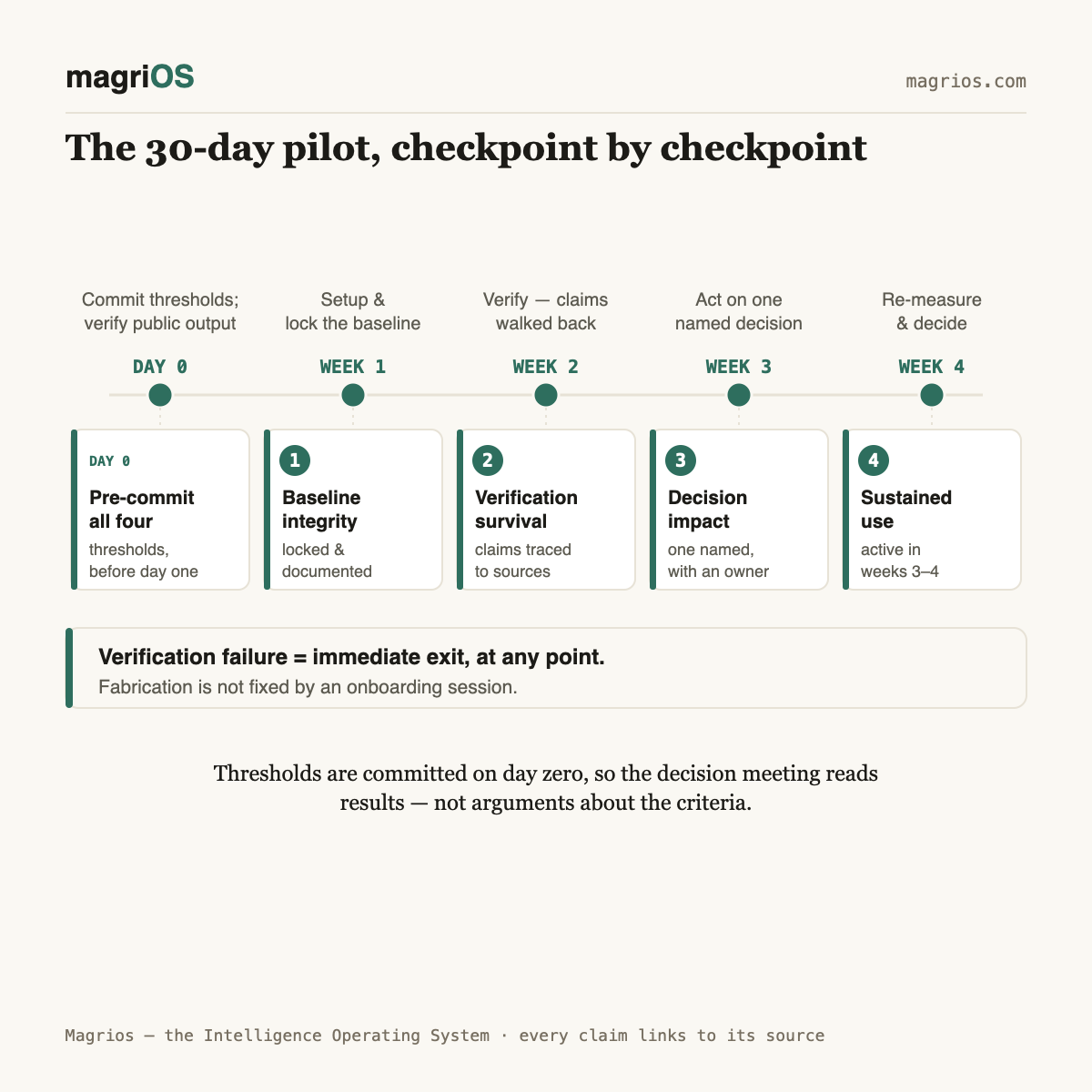
A 30-day intelligence-tool pilot must prove four things: the tool's findings survive verification against their sources; at least one finding influenced a real, named decision; the measurement baseline is locked well enough that the next measurement will mean something; and your team was still using the tool in week four. Set the pass thresholds before day one. A pilot without pre-committed criteria is a free trial with a meeting at the end.
What can 30 days actually prove?
Be precise about the pilot's evidentiary limits. Thirty days can prove that findings are verifiable, that the team adopts the tool, that one decision moved, and that a clean baseline exists. It cannot prove long-term trend value — that takes multiple measurement windows and arrives in quarters, not weeks. Design the pilot to prove what it can prove, and contract around what it cannot, rather than pretending a month settled it.
What are the four pass/fail criteria?
| Criterion | The test | Example threshold — pre-commit your own |
|---|---|---|
| Verification survival | Sample twenty claims from a pilot report; walk each back to its source | At least nineteen survive; any fabricated claim fails the pilot outright |
| Decision impact | One decision changed, written down, with the finding attached | At least one, named, with an owner |
| Baseline integrity | Benchmark questions locked and documented before the first measurement | The re-measurement uses the identical set |
| Sustained use | Tool sessions in weeks three and four, not only week one | Your team's definition of “still in use,” chosen in advance |
The thresholds are examples to pre-commit, not industry norms — the point is that they exist before the pilot generates numbers to argue about. The third row is what makes the fourth week meaningful: the locked benchmark methodology explains why a question set that drifts between measurements cannot show real change.
How should the four weeks run?
Day zero, before the pilot starts. Run the verification exercise on the vendor's existing public output. With Magrios this is possible pre-contract — the sample reports are open, and the evidence explorer lists the source behind every claim — and any vendor that enables a day-zero test has saved you a pilot week. A vendor with nothing real to inspect before the pilot begins is asking the pilot to carry weight it should not.
Week one: setup and baseline. Setup in this category should be fast — Magrios's production scans, for scale, have taken 17 to 48 minutes — so a first week consumed by configuration is diagnostic in itself. Lock the benchmark before the first measurement, and write down where it is documented.
Week two: verification on your own report. Twenty claims, walked back to sources, survival rate recorded.
Week three: act on one finding. Small is fine; named is mandatory. A finding acted on is the only evidence of decision impact that survives the contract meeting.
Week four: re-measure and decide. A weekly research cadence yields four measurement points inside 30 days. The decision meeting reads results against the thresholds committed on day zero — nothing else is on the agenda.
What if the baseline is bad news?
An honest baseline can be low, and a first measurement often is. Magrios measured its own AI visibility at 0/100 with its published method — twice, and recorded the number both times. A pilot that reports weak visibility is not a failed pilot; a pilot that cannot detect weak visibility is. If the tool reports decline during the pilot, that is the measurement working. Tools that only ever report improvement deserve more suspicion, not less.
What can a pilot not prove?
Compounding value: whether the measurement loop still informs decisions in quarter three. Do not buy a multi-year commitment on a 30-day result. Contract at pilot scope and write the renewal criteria now — for example, that the next two measurement windows must each survive the same verification test and inform at least one decision. That converts the unprovable into a scheduled test instead of a leap.
What are the decision rules?
- Pass all four: contract at pilot scope, renewal criteria attached.
- Fail verification: walk, regardless of the other three. Fabrication is not fixed by an onboarding session.
- Pass verification, fail adoption: the problem may be workflow rather than tool; one iteration is reasonable, two is a pattern.
- Pass everything except a named decision: the tool may be sound and the timing wrong — when not to buy intelligence tooling treats that as the respectable outcome it is.
The pre-pilot diligence list — security, provenance, pricing — is in the procurement question set; the pilot is what happens after a vendor survives it.