Timing questions: when buyers decide to act
Guide · Frameworks · 3 min read · last verified 2026-08-11
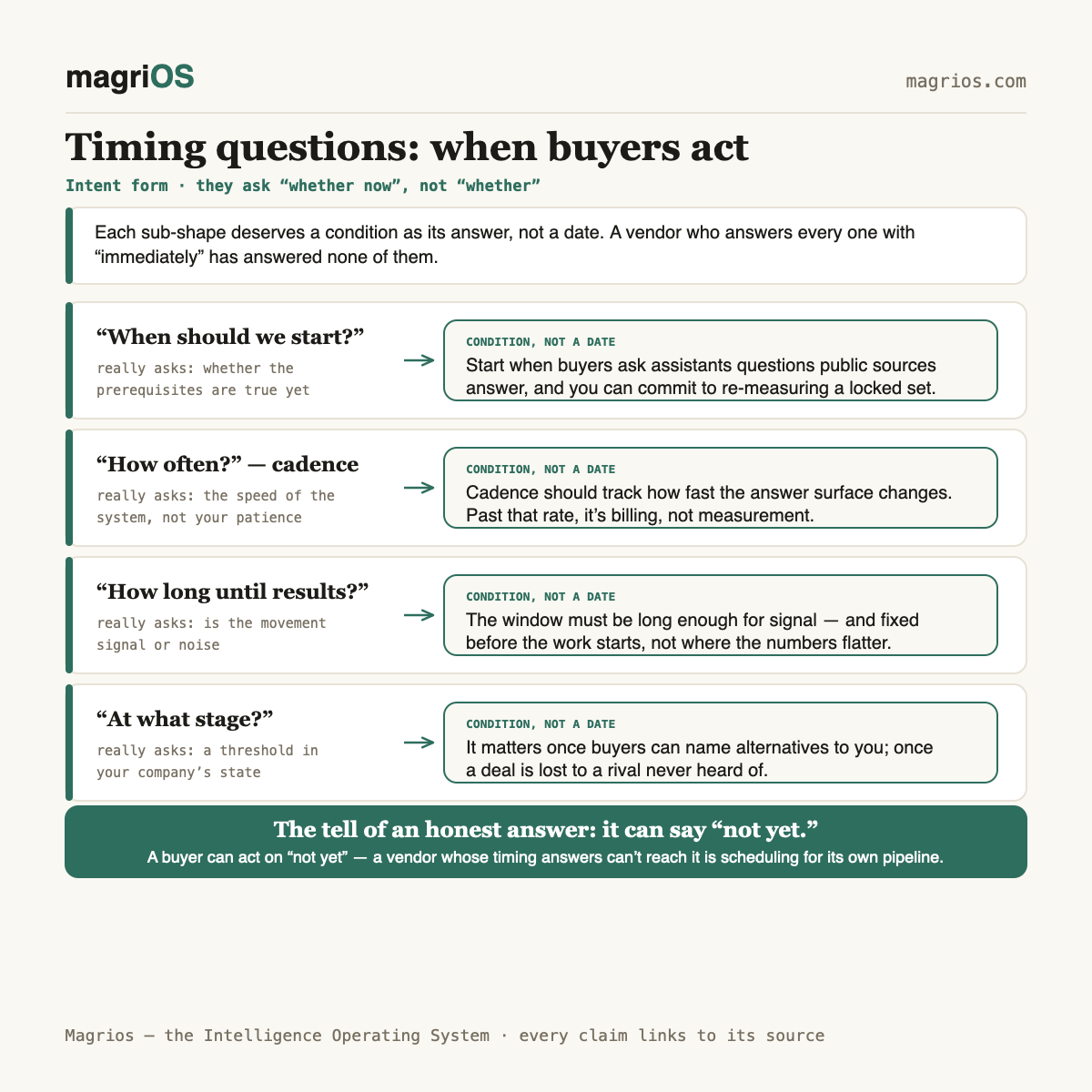
Timing questions are a buyer negotiating with their own urgency. "When should we start", "how often", "how long until results", "at what stage does this matter" — none of these ask whether to act; they ask whether now, and each deserves a condition as its answer rather than a date. A vendor who answers every timing question with "immediately" has answered none of them, and buyers grade accordingly. Our intent classifier files all of these surface patterns — when-should, how-often, how-long, how-soon, at-what-stage — under a single timing form, because they share one job: positioning an action in time.
What is "when should we start" really asking?
Whether the prerequisites are true yet. The buyer suspects the answer depends on their state, not the calendar, and the useful reply names that state. Take our own category as the worked example: start measuring AI visibility when buyers in your market actually put questions to search engines and assistants that public sources answer, and when you can commit to re-measuring on a locked question set. Before both conditions hold, a scan is a snapshot with nothing to compare against. Notice what the condition-form answer makes possible — "not yet" becomes sayable, and a buyer can act on "not yet". We keep a whole article in that register: when not to buy intelligence tooling. Any vendor whose timing answers cannot reach "not yet" is publishing scheduling advice for their own pipeline.
What do "how often" and "how long" have in common?
Both are questions about the speed of the system being measured, not about the buyer's patience. Cadence — how often — should track how fast the underlying answer surface actually changes: a market in mid-upheaval justifies frequent re-scans, a stable one does not, and a cadence sold past the change rate of the market is billing, not measurement. Duration — how long until results — is the same question from the other side: a measurement window must be long enough for movement to be signal rather than noise, and its length has to be fixed before the work starts, or the window will quietly close wherever the numbers flatter. Our own plans re-scan weekly or daily; the honest part is not the frequency. It is that the benchmark questions stay locked between scans, so no cadence, however eager, can manufacture movement on its own.
What does "at what stage does this matter" ask?
For a threshold, expressed in company state. Stage questions are readiness questions wearing a growth costume — at what size, at what point, at what stage all decode to: what must be true about us first. Calendar answers fail here twice over, because companies reach states at different ages and because the asker already knows their own state better than any vendor does. The strong answer hands over the threshold test itself: this matters once buyers in your category can name alternatives to you; it matters once a deal has been lost to a competitor the team had never heard of. The buyer runs the test privately, and the answer survives being wrong about their situation because it never claimed to know it. Threshold answers also scale where calendar answers cannot: the same conditions hold for a five-person company and a five-hundred-person one, arriving at different dates.
How should a vendor answer timing questions — and how not?
Name conditions, including the disqualifying ones, and give the buyer a free way to test them. At Magrios there is no free tier; free is the discovery step plus the open sample reports — which is precisely enough to test the readiness conditions against your own company before any money moves. The failure modes are all impersonations of urgency: dates in place of conditions, invented deadlines to compress the question, cadence upsells detached from how fast the buyer's market actually moves. On answer engines, the split we always draw: which pages rank for a timing question is measurable, scan by scan; whether assistants prefer condition-style answers over date-style ones is a hypothesis, ours and labeled. And one placement note from the twelve-shapes ontology: timing questions usually follow a yes that has not been scheduled. The buyer asking "when" has often already decided — which is exactly why an invented deadline insults them.