Procurement evaluation criteria for market-intelligence platforms
Guide · Enterprise · 3 min read · last verified 2026-08-11
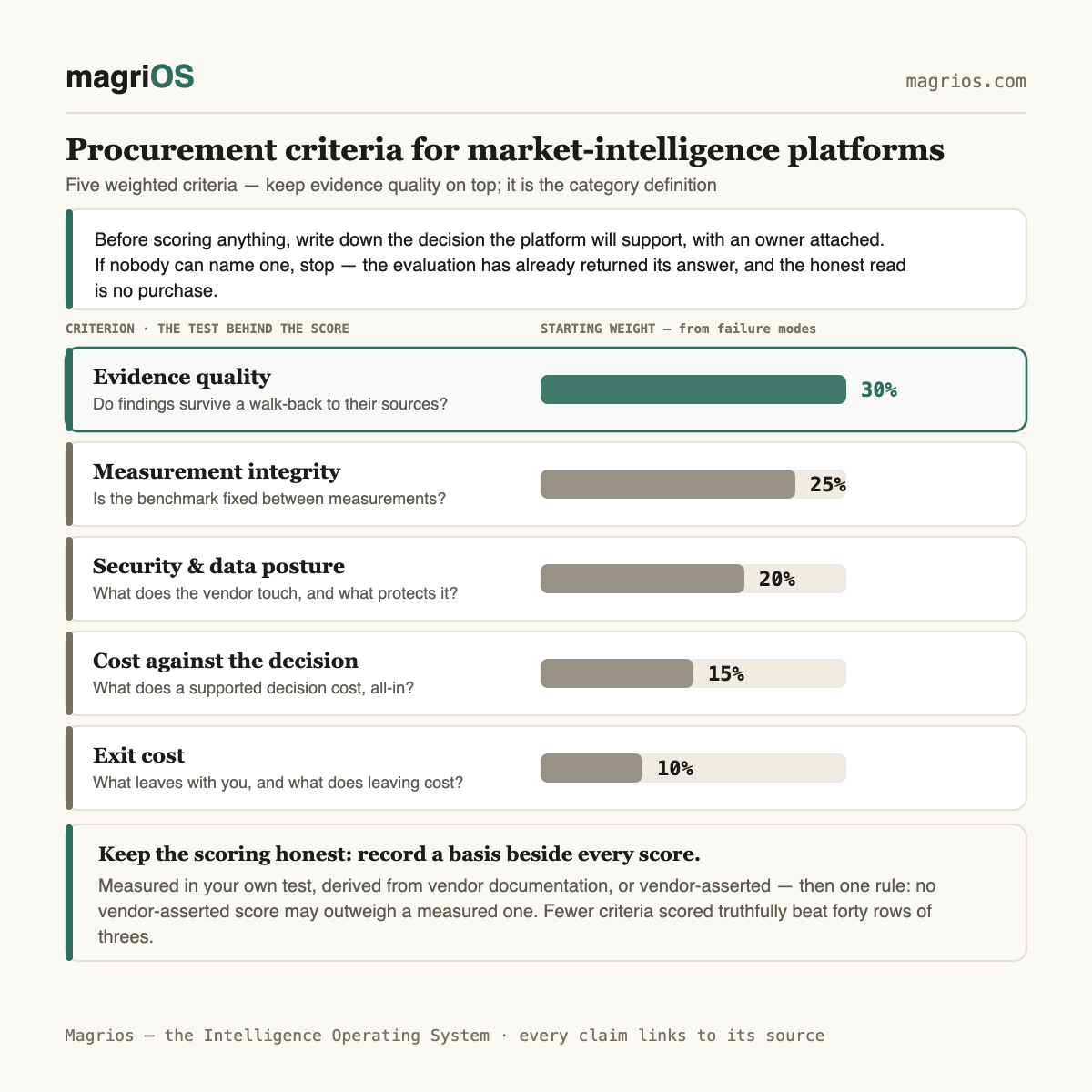
Evaluate a market-intelligence platform on five criteria: evidence quality, measurement integrity, security and data posture, cost against a named decision, and exit cost. Weight evidence quality highest — a platform that cannot show its sources fails regardless of everything else, because every other weakness is cheaper to fix than a wrong finding acted on. And before scoring anything, write down the decision the platform is supposed to support; without one, the correct evaluation result is no purchase.
What decision is the platform supposed to support?
Every criterion below assumes a named decision the platform will inform — a positioning call, a launch, a competitive response. Write it down before the first demo, with an owner attached. If nobody can name one, stop: the evaluation has already returned its answer, and when not to buy intelligence tooling is the honest read for that case.
What are the five criteria and their weights?
| Criterion | What to test | Starting weight |
|---|---|---|
| Evidence quality | Do findings survive a walk-back to their sources? | 30% |
| Measurement integrity | Is the benchmark fixed between measurements? | 25% |
| Security and data posture | What does the vendor touch, and what protects it? | 20% |
| Cost against the decision | What does a supported decision cost, all-in? | 15% |
| Exit cost | What leaves with you, and what does leaving cost? | 10% |
The weights are a starting allocation derived from failure modes, not a measured industry standard: wrong findings are the expensive failure, fake improvement the insidious one, and both cost more than any pricing delta. Adjust for context — regulated buyers move security up — but keep evidence quality on top. It is the category definition.
How do you test evidence quality?
Not in the demo — in a finished output. Take a real report, sample ten to twenty claims, and follow each to its source. Score the survival rate. Favor inconvenient claims: specific numbers, statements about small competitors, anything that would embarrass the vendor to have invented. Magrios makes this test free to run — its sample reports are open pre-purchase, with the evidence explorer listing every source page — and that openness is itself the criterion in miniature: a vendor that will not let you walk a real output backwards before contract scores zero here, not blank.
What does measurement integrity look like?
A market-intelligence platform's value compounds only if measurement N and measurement N+1 are comparable. A tool that re-derives its question set on every run can show improvement that is an artifact of the re-derivation. The integrity test is one request: show me two consecutive measurements of the same fixed benchmark, including one where the number went down. Fixed questions, visible declines — the locked benchmark methodology explains why both halves matter. A vendor that cannot show a decline has never measured anything.
What does the platform really cost?
The subscription is usually the smallest number in the true total. Add the team time to verify findings — small when evidence is source-linked, enormous when it is not — the time to act on them, and the switching cost you are creating. Then divide by the decisions the platform will actually support in a year. A cheap tool informing zero decisions is infinitely expensive. Note who can do this arithmetic: pricing a supported decision belongs to the economic buyer, not the evaluation team — procurement vs the economic buyer is about keeping those roles straight.
How do you keep the scoring honest?
Two practices. First, fewer criteria scored truthfully beat forty rows of threes; the five above are enough. Second, record a basis beside every score: measured in your own test, derived from vendor documentation, or vendor-asserted. Then apply one rule — no vendor-asserted score may outweigh a measured one. The evaluation should meet the same standard as the product it is judging: claims with a basis, or no claims.
What will leaving cost?
Ask on the way in: what exports, in what format, and what happens to your benchmark history when you go. Measurement history is precisely the asset that does not rebuild quickly with the next vendor — losing it restarts your baseline from zero. Price that now, while it is still negotiable.
The full sendable version of these criteria — security floor and provenance requirements included — is in the procurement question set. Score what comes back, and let the walk-back test break the ties.