Risk questions: what buyers fear and how evidence answers it
Guide · Frameworks · 3 min read · last verified 2026-08-11
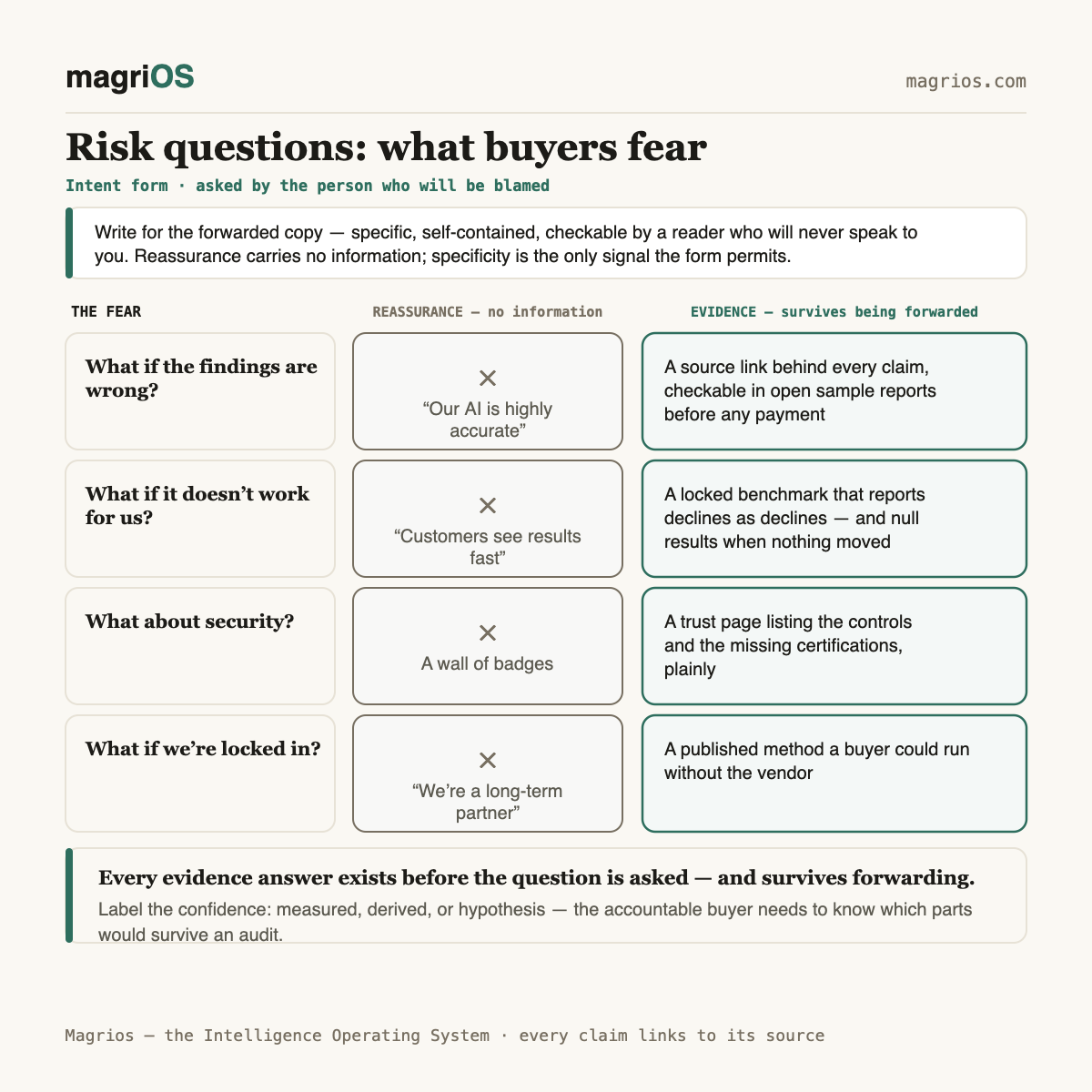
Risk questions are asked by the person who will be blamed. "What happens if this goes wrong", "what breaks", "can this backfire" — the asker is not seeking reassurance, which any vendor supplies in unlimited quantity, but failure modes named in advance, each paired with what happens next. The vendor who can say precisely what fails, under which conditions, and what the buyer sees when it does has clearly been through the failure. The vendor who says "that rarely happens" has not.
Who asks risk questions, and why does that change the answer?
The accountable individual — the person whose name sits on the vendor decision when it gets reviewed later. That identity changes the medium as much as the content, because risk answers travel: into a procurement thread, a security review, a renewal debate. Write for the forwarded copy. It has to be specific, self-contained, and checkable by a reader who has never spoken to you and never will. A risk answer that only works with a salesperson standing beside it fails at the exact moment it is used.
Why does reassurance fail as an answer?
Two structural defects. It is unfalsifiable — "highly reliable" cannot be tested by the reader, only believed. And it is symmetric — every vendor asserts dependability with identical fluency, so the assertion carries no information that distinguishes anyone. Reassurance also inverts under a practiced eye: a reviewer who hears "that never happens" tends to infer, correctly, that the failure modes were never catalogued. In risk answers, specificity is not a style preference. It is the only signal the form permits.
What evidence actually answers each fear?
| The fear | The reassurance version | The evidence version |
|---|---|---|
| What if the findings are wrong? | "Our AI is highly accurate" | A source link behind every claim, checkable in open sample reports before any payment |
| What if it does not work for us? | "Customers see results fast" | A locked benchmark that reports declines as declines — and null results when nothing moved |
| What about security? | A wall of badges | A trust page listing the controls and the missing certifications, plainly |
| What if we are locked in? | "We are a long-term partner" | A published method a buyer could run without the vendor |
The right-hand column shares one property: every item exists before the risk question is asked, and every item survives being forwarded.
Can naming your own gaps backfire?
The fear is that admissions arm competitors and spook reviewers. Our own practice runs the other way: the Magrios trust page states plainly that we hold no SOC 2 or ISO 27001 certification yet and run production in a single region — beside the controls that do exist, tenant isolation and access floors covered by automated tests among them. The reasoning is that disclosure is what makes the listed strengths legible; a reviewer who catches one omitted gap re-reads the whole page as marketing. Label the confidence correctly, though: that trust effect is a derived judgment from how vendor reviews behave, not a measurement. The part that needs no judgment call is procedural — the reviewer runs their risk assessment with your gaps in hand either way. The only variable under your control is whether they hear the gaps from you.
Where do confidence labels fit in a risk answer?
A risk answer mixes claim types, and the mix should be visible. "Requests for another tenant's resources return 404" is a measured claim — a test suite exercises it. "Naming gaps builds reviewer trust" is derived at best. "Answer engines favor content that enumerates failure modes" is a hypothesis, and if we advance it — a risk-form question is, after all, a request for enumerated failure modes — we advance it labeled. Our reports carry a three-level confidence taxonomy: measured, derived, hypothesis, because the accountable buyer needs to know which parts of a risk answer would survive an audit and which parts are the vendor's judgment. What lets them check the measured parts without asking anyone's permission is an evidence trail — and for risk questions specifically, permission-free checking is the entire product.