Vendor risk assessment for AI-powered market intelligence tools
Guide · Enterprise · 4 min read · last verified 2026-08-11
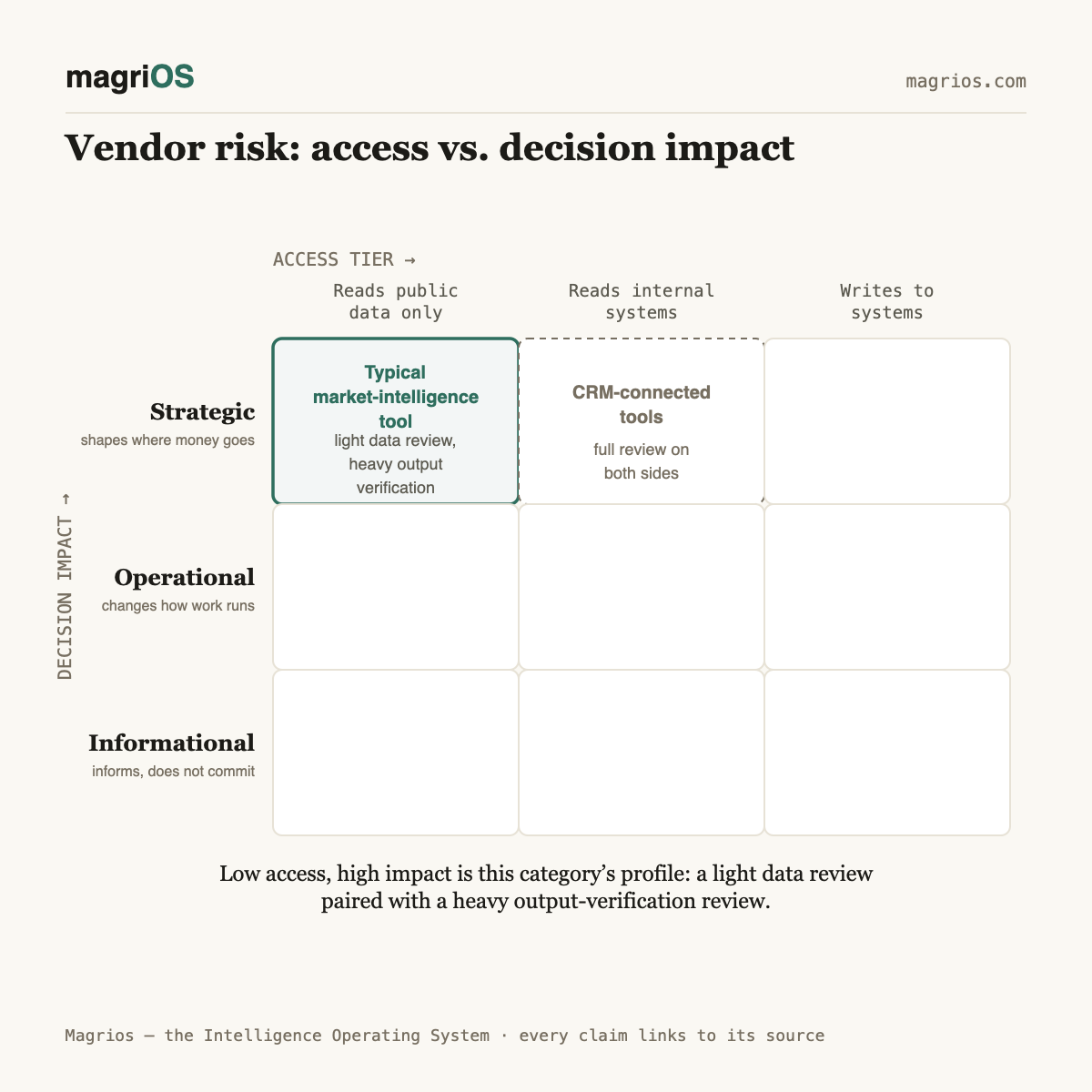
Vendor risk assessment for an AI-powered market intelligence tool comes down to four questions: what data the tool touches, whether its outputs can be verified, what its security posture actually is, and what happens when it fails. Most tools in this category read public data and need no access to your systems, which places them in a lower data-risk tier than the average AI purchase. The risks a standard questionnaire misses are on the output side — findings that cannot be traced, confidence that has no basis, and fabrication presented as research.
Why do AI research vendors need a different risk lens?
A classic vendor review assumes the risk flows inward: you hand the vendor data, and the review asks how well they protect it. Market-intelligence tools mostly invert this. What they need from you is small — often a domain name and some business context. The material risk flows outward: their findings enter your strategy discussions, your board decks, and your roadmap. A fabricated competitor claim does not breach your data; it corrupts your decisions.
So the assessment has two halves, and the second is the one most questionnaires skip.
| Direction | The risk | Standard questionnaire coverage |
|---|---|---|
| Data in | The vendor mishandles what you give it | Extensive |
| Decisions out | You act on findings that were never true | Almost none |
What risk tier does the purchase sit in?
Tier before questions, so the effort stays proportional. Two axes do the work.
- Access. Does the tool read only public data, read your internal systems, or write to them? A tool that takes a domain name and reads public pages sits at the lowest access tier. One that connects to your CRM does not.
- Impact. Are the outputs informational, operational, or strategic? Market intelligence usually lands at strategic — it shapes where money goes.
Low access with high impact is the characteristic profile of this category: a light data-protection review paired with a heavy output-verification review. What is a vendor risk tier covers the general method.
What are the four assessment areas?
| Area | The question | Evidence that answers it |
|---|---|---|
| Data handling | What exactly do you read, and what do I give you? | A written input surface, ideally one sentence long |
| Output integrity | Can every claim be traced to a source I can open? | A live report, not a slide about one |
| Security posture | What controls exist, and how are they verified? | Certifications, or named controls with automated tests |
| Failure modes | What happens when a run fails or the vendor disappears? | Export terms, refund rules, honest availability statements |
Two of these deserve expansion.
Output integrity is testable before you sign. Ask for a real, finished output — not a demo environment, a complete report on a real company. Then follow ten claims back to their sources. Magrios is built to pass exactly this test: its sample reports are public before any purchase, every claim carries a source link, and where nothing is publicly knowable the report says “no public evidence found” rather than filling the gap. Whichever vendor you assess, that is the standard worth demanding. The walk-back takes about ten minutes and predicts more than any questionnaire section; evidence-first AI explains how to run it properly.
Security posture is about controls, not logos. An early-stage vendor may hold no SOC 2. That is information, not a verdict. The follow-up question is what exists instead — and whether the vendor volunteers it. Magrios publishes a trust page stating plainly that it has no SOC 2 or ISO 27001 yet and hosts in a single region, next to the controls that do exist: fail-closed tenant isolation, deny-by-default role permissions, and automated test suites that run on every change. A vendor that lists its gaps unprompted has done part of your risk assessment for you — as our own trust page puts it, a trust page that lists only strengths is a marketing page.
Which AI-specific checks do questionnaires miss?
Three checks, all runnable in under an hour:
- The fabrication check. Follow claims to sources, starting where invention is cheapest: the competitor too small to be newsworthy, the suspiciously precise number, the quote nobody else carries.
- The refusal check. Find a question the public record cannot answer and watch what the tool does. The honest behavior is a visible null. The dangerous behavior is a fluent answer.
- The measurement check. If the tool tracks change over time, ask whether the benchmark stays fixed between measurements. A benchmark that shifts with every run can manufacture improvement.
When should the assessment stop the purchase?
Stop if the vendor cannot produce a single traceable output, if confidence labels carry no stated basis, or if nobody on your side can name the decision the tool will inform. The last is a buyer-side failure and the most common one; when not to buy intelligence tooling takes that case seriously. For everything else, the procurement question set turns this framework into questions you can send today.