Ownership questions: who is accountable for a result
Guide · Frameworks · 4 min read · last verified 2026-08-11
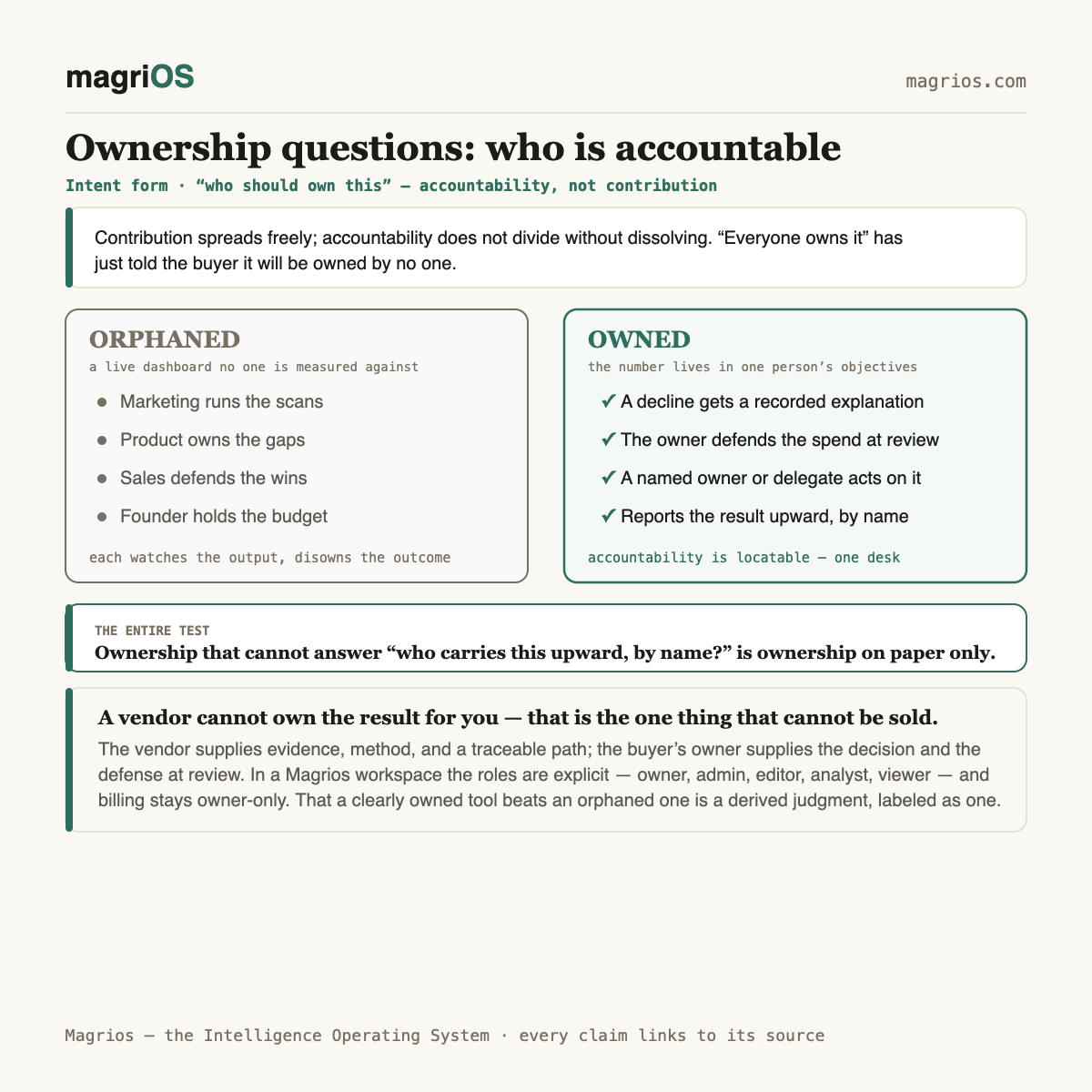
An ownership question — "who should own this," "whose job is this," "who owns AI visibility inside a company" — is a buyer looking for the desk a result will sit on before they go and create the result. The honest answer names a role and its accountability, not a person and never the vendor. And it says the part most vendors leave out: a tool with no owner produces a number nobody acts on, so if the buyer cannot yet name the owner, the honest move is to settle that before buying anything.
Who is the buyer actually trying to name?
A single role that can be held to account. Ownership questions hide a distinction between the many people who will contribute to a result and the one who answers for it — responsible versus accountable. Contribution spreads freely; accountability does not divide without dissolving. When a buyer asks who should own AI visibility, they are not asking who will touch it, because several teams will. They are asking whose objective it rolls into, whose review it appears in, and — the same person a risk question is really about — who gets the blame when it slips. A vendor who answers "everyone owns it" has just told the buyer it will be owned by no one.
Why do new tools so often create orphaned accountability?
Because a tool arrives as a capability, and capabilities do not ship with an owner attached. Marketing runs the scans, but the gaps they expose are the product team's, the wins are sales's to defend, and the budget is the founder's — so each group can watch the output while disowning the outcome. The result is a familiar organizational failure: a live dashboard no one is measured against. The tell is a subscription renewing on habit while the number it produces changes nobody's week. This is the readiness condition sitting under many timing questions — "when should we start" often decodes to "who would own this if we did," and until that has an answer, starting is early.
What separates an owned result from an orphaned one?
| Orphaned | Owned | |
|---|---|---|
| Where the number lives | On a shared dashboard | In one person's objectives |
| What a decline triggers | A note, then nothing | An explanation from the owner, on the record |
| Who defends the spend | No one, until it is cut | The owner, at the review |
| Who acts on a finding | Whoever has time | The owner, or a named delegate |
| How you can tell | You cannot | Ask who reports the result upward, by name |
The last row is the entire test. Ownership that cannot answer "who carries this upward, by name" is ownership on paper only.
Can a vendor own the result for you?
No — and a vendor implying otherwise is selling the one thing that cannot be sold. A vendor supplies the evidence, the method, and a traceable path from source to recommendation; the buyer's owner supplies the decision, the defense at review, and the account of what moved and why. Accountability is the residue left inside the company after every service has been bought. We build for that division on purpose. In a Magrios workspace the roles are explicit — owner, admin, editor, analyst, viewer — and billing stays owner-only, so authority over the account cannot drift to whoever happens to be signed in. The same principle runs through the pipeline behind our own knowledge library: no writer reviews their own work, because self-review erases the line between doing a thing and answering for it. Separation of duties is not bureaucracy; it is what keeps accountability locatable.
How should a vendor answer an ownership question — and how not?
Hand over the role profile, not a reassurance. Describe the owner the tool actually needs — the seniority, the neighboring responsibilities, the authority to act on a finding — and name the failure where the tool is bought and never assigned. Do not flatter the buyer with "it runs itself"; a result that needs no owner is a result nobody uses, discovered one renewal too late. Label the confidence, too: that a clearly owned tool outperforms an orphaned one is a derived judgment about how organizations behave, not a measurement we ran — the kind of claim the confidence taxonomy exists to keep tagged. The same discipline governs how we read answer engines. We can count, scan to scan, how many public pages an assistant draws on for an ownership question — that count is measured. Why it leans toward one org-design page over another we never assert; that reading is held as a hypothesis and marked as one. The procurement desk assigns the owner regardless — the only thing a vendor controls is whether they were honest that an owner was required at all. And owning the result means owning its attribution: the moment someone asks the owner what actually drove the change.