Selection questions: how buyers shortlist without trusting listicles
Guide · Frameworks · 4 min read · last verified 2026-08-11
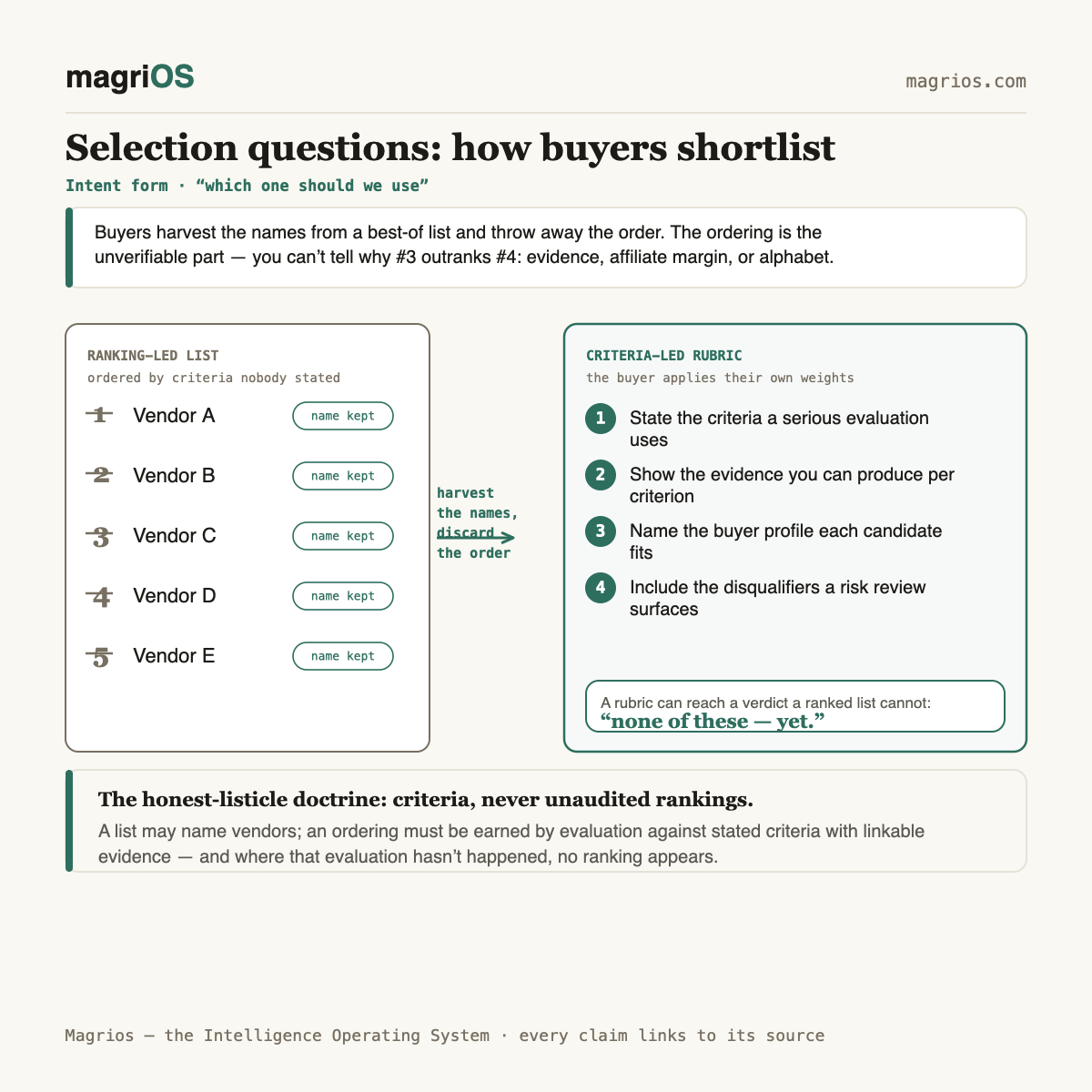
Buyers use best-of lists for the names and throw away the order. That is the working answer to how they shortlist: a selection question — which one, which framework, which approach — asks someone to exercise judgment on the buyer's behalf, and buyers have learned that most published pick-lists are rankings nobody audited, ordered by criteria nobody stated. So they harvest the candidate names, discard the ranking, and rebuild the decision against their own criteria. A vendor who wants to be useful at this stage publishes the criteria and the evidence, not a numbered list.
What does a selection question actually request?
Delegated judgment over a known set. That second property separates it from a tooling question: "which platforms handle X" wants an inventory of what exists, while "which one should we use" assumes the set and asks for the pick. Our intent classifier keeps the two apart and tests tooling first, because the inventory question happens to open with "which" and would otherwise be filed as a pick. The distinction carries past taxonomy into ethics: an inventory can be complete and neutral. A pick can be neither — it can only be transparent about the judgment it applies.
Why do buyers strip the ranking and keep the names?
Because the ordering is the unverifiable part. From outside, a reader cannot tell why the third entry outranks the fourth — evidence, affiliate margin, or alphabet. The names, by contrast, are cheap and mostly reliable; even a compromised list tends to contain real vendors. So the list's practical function is candidate discovery, whatever its author intended. Orderings also decay in silence: a ranking written before either product's last three releases still displays the same confident sequence. The rational response is exactly the observed one — trust the roster, audit the order yourself.
What does a criteria-led answer look like?
| Ranking-led answer | Criteria-led answer | |
|---|---|---|
| What the buyer receives | An ordering | A rubric to apply |
| Where the judgment lives | Hidden in the sequence | Stated as criteria |
| How it ages | Silently | Visibly — criteria outlive scores |
| What it demands of the author | Nothing checkable | Evidence per criterion |
| Who can disagree usefully | Nobody — against what? | Anybody — against the rubric |
A criteria-led answer states what matters for this decision, why it matters, and what evidence bears on each criterion — then lets the buyer apply their own weights. Procurement teams already evaluate this way; a vendor who answers a selection question well is doing the procurement desk's first draft for free, and the drafts get compared. The rubric format also fails gracefully: a buyer who rejects your criteria has still learned what you believe matters, which is more than any ordering communicates.
How does the honest-listicle doctrine handle "best X" pages?
It is the rule Magrios publishes under: criteria, never unaudited rankings. A list may name vendors; an ordering has to be earned by evaluation against stated criteria with evidence we can link, and where that evaluation has not happened, no ranking appears. The doctrine also permits the least commercial answer a selection question can receive: none of these, yet. Some buyers asking "which one" are buyers for whom deferral is correct, and a criteria-led format can reach that verdict honestly — when not to buy intelligence tooling is ours in that genre. A ranked list cannot say "none of the above". That limitation belongs to the format, not to any particular author.
Where does this leave a vendor answering "which one"?
Publish the rubric. State the criteria a serious evaluation would use, show the evidence you can produce against each, name the buyer profiles each candidate fits, and include the disqualifiers — the questions a vendor risk assessment will surface anyway. Then expect the buyer to re-weight everything; that is the design working, not failing. Answer engines complicate the form without changing the advice. Which pages rank for a best-X question is measurable, and ranked lists have historically filled that surface; whether assistants reproduce a list's ordering or dissolve it into criteria is a hypothesis we track, not a fact we assert. A vendor's safest position under either outcome is identical: be the page whose criteria survive being quoted without the order. And know which form you are actually in: once the shortlist narrows to two, the buyer stops asking "which one" and starts asking what the difference is — a form with its own, sharper evidence standard.