Aggregation is a commodity now: what market intelligence is actually worth
Guide · Market Growth · 4 min read · last verified 2026-08-11
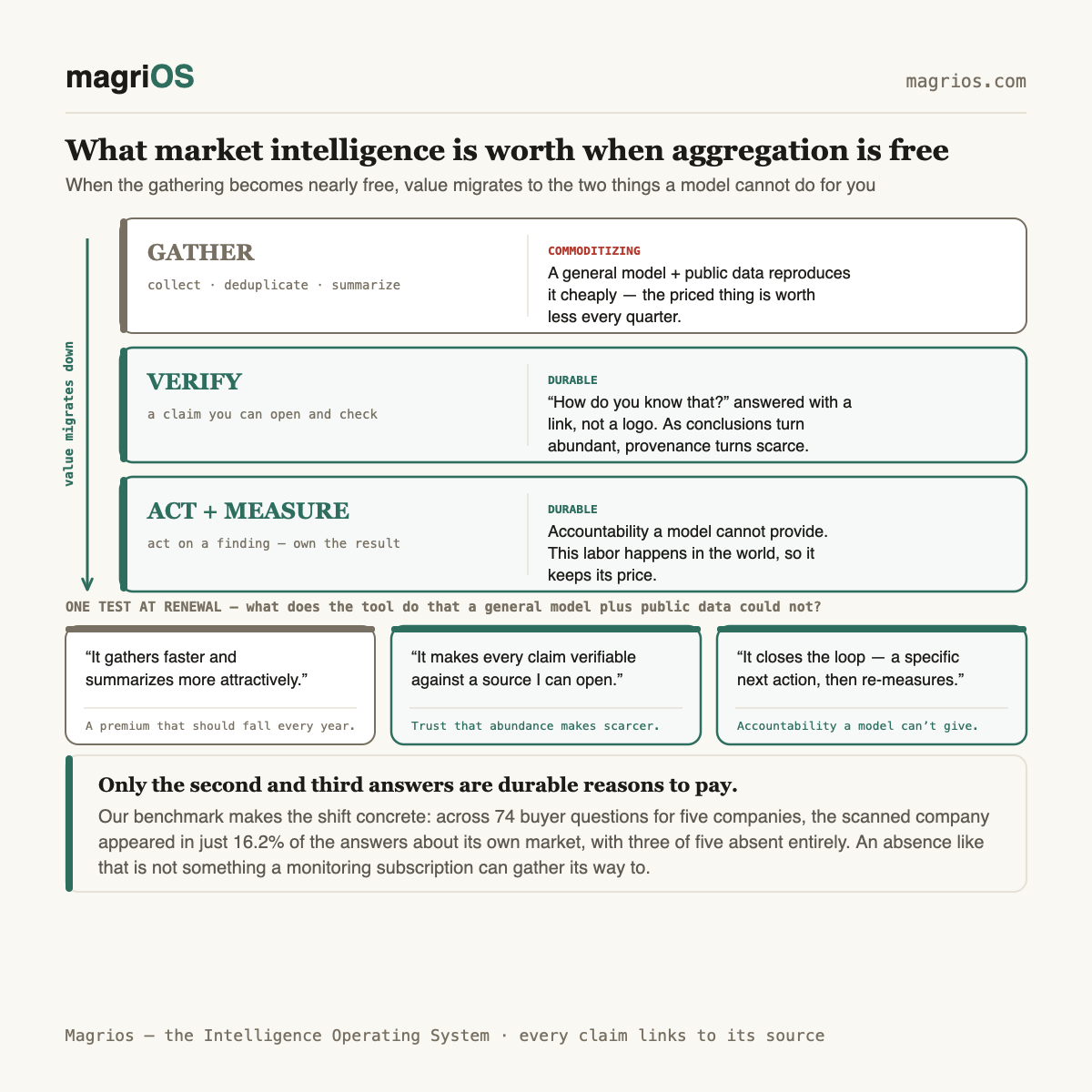
For most of the history of market intelligence, the thing you were paying for was gathering. The relevant signals lived in filings, press coverage, review sites, and competitors' own pages, and the expensive, valuable act was pulling them together into something legible. That is no longer the expensive part. A general model with access to public data now reproduces most of what "monitor these companies and summarize what is new" used to require — cheaply, and in minutes. When the thing you were paying for becomes nearly free, one honest question follows: what are you actually paying for now?
What did market intelligence used to sell?
It sold aggregation. The historical value of the category was that someone, or something, went out across fragmented, scattered sources and brought back an organized view — a report, a feed, a dashboard of what competitors and markets were doing. The work was real and the price was fair, because the work was genuinely hard. Finding the signal, deduplicating it, structuring it, keeping it current: this took people, tooling, and time. A company paid to skip that labor. Every operating model in the category — the research house, the monitoring platform, the data terminal — is a variation on the same sale: we do the gathering so you do not have to.
What did AI actually change?
It made the gathering cheap. This is the uncomfortable part for the category, and it is worth stating plainly rather than hedging: the specific labor the category was built to sell — collect, deduplicate, summarize, keep current — is now largely reproducible by a general model with access to public data. Not perfectly, not for every regulated or paywalled source, but for the broad "watch these companies and tell me what changed" job that anchors most subscriptions, the marginal cost of gathering has collapsed. A small team can now approximate in an afternoon what used to justify a five-figure annual contract.
When the marginal cost of a thing falls to near zero, its price cannot hold, and its value has to move somewhere else. The question is where.
So what is actually worth paying for now?
Two kinds of work a model cannot do on your behalf, and both sit downstream of gathering.
The first is verification. A model will produce a fluent, confident summary whether or not it is correct, and fluency is not accuracy. The scarce, valuable thing is no longer the summary — it is a claim you can open and check: a specific source behind a specific finding, so a skeptic can confirm it without trusting the tool. As AI-generated conclusions become abundant, the premium shifts to provenance. The ability to answer "how do you know that?" with a link, not a logo, is worth more than the conclusion itself.
The second is action and measurement. Gathering tells you what is true; it earns nothing back when you act on it. What a model cannot capture here is not information — it is accountability: doing something with a finding and being answerable for whether it worked. That labor happens in the world, not in a summary, which is exactly why it keeps its price while gathering loses it. The mechanics of that loop — and why most tools stop right before it — are a separate argument, the action gap; for pricing, it is enough to see that it is the part of the job a model cannot take off your hands.
How do you tell a commodity from a tool worth paying for?
Use one test at renewal: ask what the tool does that a general model plus public data could not. Be strict about the answer.
- If the honest answer is "it gathers faster and summarizes more attractively," you are paying a premium for something that is commoditizing under you. That premium will keep eroding.
- If the answer is "it makes every claim verifiable against a source I can open," you are paying for trust that abundance is making scarcer.
- If the answer is "it closes the loop — it turns findings into a specific next action and re-measures whether my position actually moved," you are paying for accountability a model cannot provide.
The first is a cost that should fall every year. The second and third are the only durable reasons to pay.
Why does the gap keep widening?
Because the two forces compound. As models improve, the commodity floor under gathering keeps dropping — so more of what you pay for gets cheaper every quarter. At the same time, more of what actually moves a company's position sits on the far side of that commodity line, where faster gathering cannot reach it. Our own research makes the shift concrete: a benchmark across 74 buyer questions for five companies found the scanned company in just 16.2% of the answers written about its own market, with three of the five absent entirely. An absence like that is not something a monitoring subscription can gather its way to; it is a fact about where value has moved. Each quarter, the priced thing is worth less and the valuable thing is something the priced thing was never built to do.
The category's price was set when gathering was hard. Gathering is no longer hard. The tools worth paying for from here are the ones doing the two things that stayed hard: proving what is true, and being accountable for what changed.