Causation questions: what actually drove the result
Guide · Frameworks · 4 min read · last verified 2026-08-11
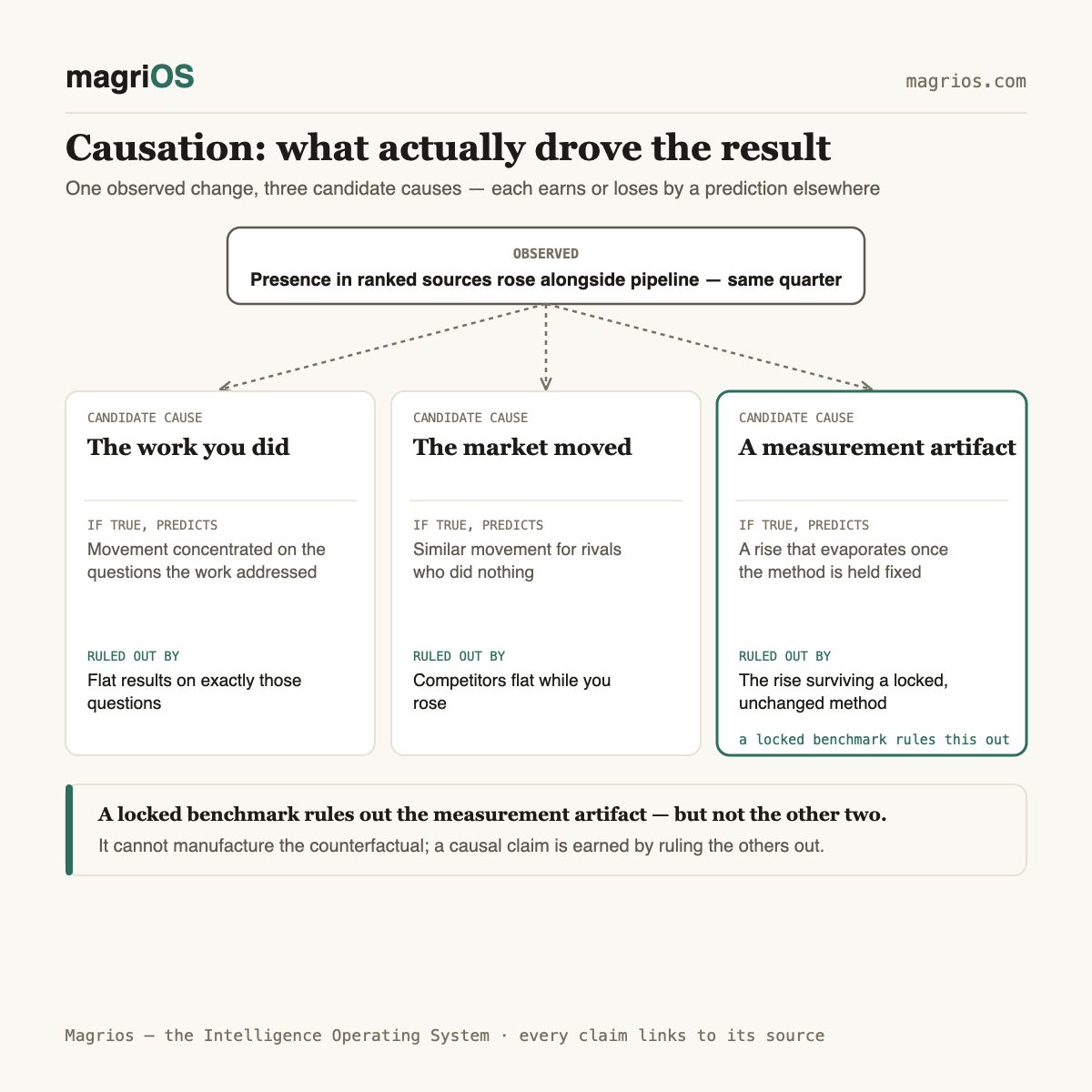
A causation question — "why did our numbers move," "did the work actually cause this," "why do we keep losing these deals" — asks for attribution, which is the hardest thing evidence can be asked to supply. The buyer wants to know what drove a result so they can do more of what worked and stop paying for what did not. The honest answer separates the thing that happened from the reasons it might have happened, names the ones it cannot rule out, and refuses to promote a coincidence in timing into a cause.
What is a buyer really asking when they ask "why"?
For a cause they can act on, not a story that fits. Every result has a story available after the fact — the launch, the campaign, the new hire — and the story is usually true and almost never sufficient. What the buyer needs is the counterfactual: would the number have moved anyway? A cause worth acting on is one whose absence would have changed the outcome, and most after-the-fact explanations never test that. The buyer asking "why," however they phrase it, is asking which explanation survives its own alternatives.
Why is co-movement not causation?
Because two things can climb together while a third lifts both, or while neither touches the other. A vendor's presence in ranked sources and a buyer's pipeline can rise in the same quarter because a competitor stumbled, because the category caught a wave of attention, because a season turned — none of which the vendor's work caused, all of which the vendor's chart will gladly take credit for. This is the error the Magrios footer refuses on the product's behalf: our reports measure presence in public sources and decline to claim causation, because presence and outcome moving in step is not proof that one moved the other.
What could explain the same rise?
| A candidate cause of the same rise | What it would predict elsewhere | What would rule it out |
|---|---|---|
| The work you did | Movement concentrated on the questions the work addressed | Flat results on exactly those questions |
| The market moved | Similar movement for rivals who did nothing | Competitors flat while you rose |
| A measurement artifact | A rise that evaporates once the method is held fixed | The rise surviving a locked, unchanged method |
The rows are not ranked, because which one dominates is the entire object of the investigation. A causal claim is earned by ruling the others out, one prediction at a time — and a vendor who has not tried to rule them out is holding an anecdote with a timestamp.
What can a locked benchmark honestly attribute — and what can't it?
It can remove one suspect outright. When the question set is fixed and re-asked unchanged, a change in results cannot be the ruler shifting, so the locking discipline eliminates the measurement artifact — the third row. What locking cannot manufacture is the counterfactual for the first two: it can show that you rose and, by tying movement to the specific pages that changed, narrow where the rise came from, but it cannot prove the market would not have carried you there without the work. Honest attribution from a locked benchmark therefore sounds like this: results moved, on these questions, alongside these page changes — stated as an association with its confounders named, not as a causal trophy. The strongest version exposes each link from source to conclusion so a reader can audit the chain themselves, which is the reason an evidence chain beats a summary.
How should a vendor answer "did it work?" without overclaiming?
Grade the claim before making it. Attribution rarely earns the "measured" label: that a result occurred can be measured, but that your work caused it is derived at best, and often a hypothesis — and saying so is not weakness, it is what separates a vendor a buyer can trust with the next question from one they cannot. The failures run in a set: claiming sole credit for a result with obvious co-causes; burying the confounder that a competitor's outage or a demand surge did the lifting; presenting "it rose after we shipped" as though sequence were mechanism. This is the discipline a measurement question demands from the opposite side — method before outcome, cause held to a stricter bar than correlation. A causation question meets answer engines at the honesty line the rest of this argument rests on. What can be measured is the set of public pages an engine surfaces for it, run after run. What drives the engine to prefer a page that admits its confounders over one selling a single tidy cause is inference, not observation — and it is filed as inference. A buyer who catches a vendor promoting co-movement to causation does not merely discount that claim; they reread every earlier number as possibly the same trick. Attribution honesty costs you once. Overclaiming bills you every quarter after.