Method questions: how buyers learn a process before buying a tool
Guide · Frameworks · 3 min read · last verified 2026-08-11
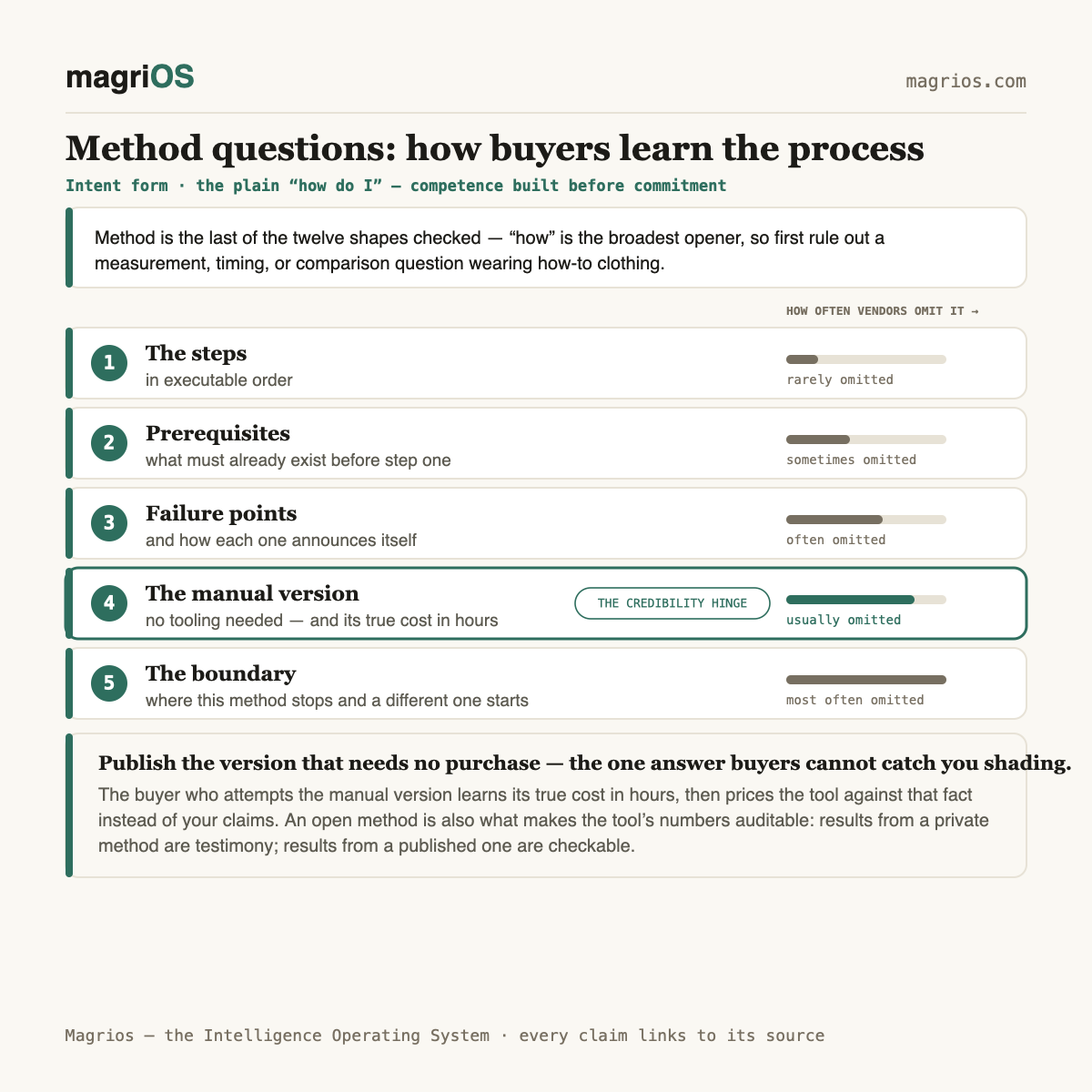
A method question — the plain "how do I" — is a buyer building competence before commitment, and most people asking one will never buy anything from you. The honest answer teaches the complete process, including the version that requires no purchase. That standard is not generosity. It is the only version buyers cannot catch you shading, because the first practitioner who follows the steps discovers immediately whether they work without your product attached.
Why is method the last shape our classifier checks?
Of the twelve patterns in the Magrios intent classifier, method is deliberately the final one tested. "How" is the broadest opener in the language: measurement's "how do we measure", timing's "how long", difference's "how do they differ" all begin the same way, and each is claimed first by its more specific pattern. Method receives the remainder — the how-questions genuinely about process. That ordering encodes an editorial discipline worth copying by hand: before treating a question as a how-to, check whether it is a measurement, timing, or comparison question in how-to clothing. "How do I choose between them", for instance, is a pick wearing an apron. Answer it with process steps and you have dodged the judgment the buyer requested — the twelve-shapes overview walks the full precedence.
What is the buyer really asking?
For competence, ahead of any purchase — and the sequence is not optional. A buyer who cannot describe a process cannot evaluate a tool's claims about it; to someone who does not know the work, every demo looks equally plausible. So method questions arrive earliest in the journey and do double duty: they teach the work, and they audition the teacher. The vendor who explains the process most clearly collects a presumption of competence that outlasts the article — but only if the explanation stands alone, because the buyer at this stage has no intention of getting on a call to hear step four. Vendors persistently misread this stage as top-of-funnel waste because it converts at nothing. It is closer to the entrance exam for every conversation that follows.
What does a complete method answer include?
Five things, roughly ordered by how often vendors omit them: the steps, in executable order; the prerequisites — what must already exist before step one; the failure points, and how each announces itself; the manual version — how to run the process with no purchased tooling, and what it costs in hours; and the boundary — where this method stops applying and a different one starts. The fourth is the credibility hinge. A method that only functions with the vendor's product installed at step two is an onboarding document mislabeled, and practitioners name it as such in exactly the public places buyers read next.
Why publish a method that makes your tool optional?
We publish our locked benchmark methodology completely enough to run without us, and the reasons survive scrutiny better than the fear does. First, the buyer who attempts the manual version learns its true cost in hours, then prices the tool against that fact instead of against our claims — the strongest pricing argument we never have to make. Second, an open method is what makes the tool's numbers auditable: results from a private method are testimony, results from a published one are checkable, the same logic that makes an evidence trail worth more than a scorecard. Third, candor about scope: some readers of a method article should not buy at all, and the method register is where a vendor can say so plainly — ours does.
How do answer engines treat method content?
Keep the halves separate. The measured half: which pages rank for a given how-question is observable in every scan we run. The hypothesis half, labeled: how-questions get answered as steps, so a page organized as complete, self-sufficient steps sits closer to a usable answer than prose about the topic — plausible, unverified from outside, and stated here as a hypothesis rather than a finding. The half that needs no hypothesis is older than answer engines: practitioners cite the teacher. The person who learned the process from your page names it in the threads, internal docs, and private recommendations no scan reads — the channel where method content does its quietest compounding.