The twelve shapes of buyer questions
Guide · Frameworks · 5 min read · last verified 2026-08-11
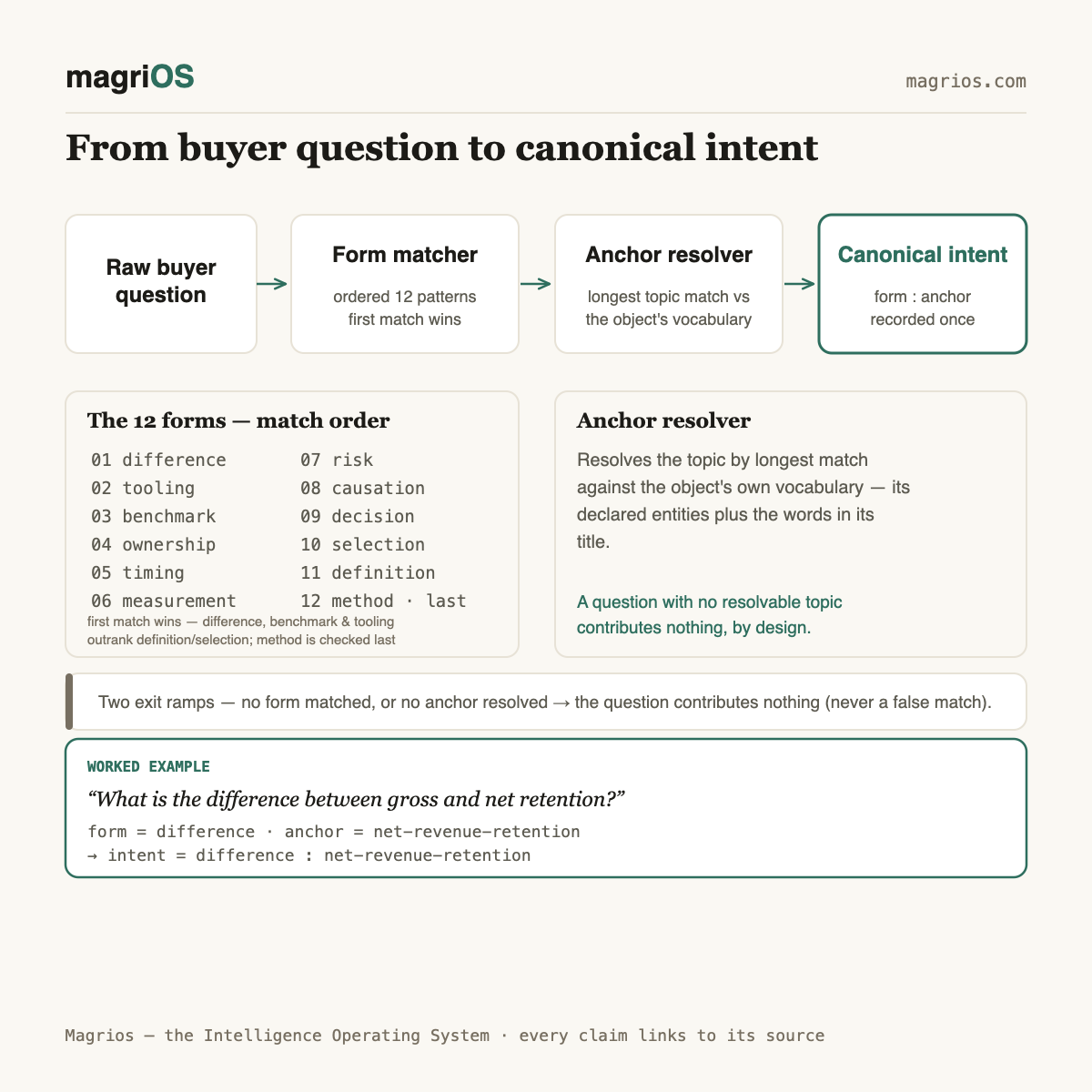
Buyer questions arrive in twelve recurring shapes: difference, tooling, benchmark, ownership, timing, measurement, risk, causation, decision, selection, definition, and method. Each shape names a different job the buyer is trying to get done — comparing two options, asking for a number, assigning responsibility, sizing a failure. The list is not a proposed theory; it is the classification table shipped in the code of the Magrios knowledge factory, written pattern by pattern against the real questions in our published corpus. And a shape alone is never enough: our system records an intent only when a form pairs with a concrete topic anchor, for reasons this article explains.
What are the twelve forms?
| Form | What the buyer is doing | Sounds like |
|---|---|---|
| Difference | Choosing between two named options | "What is the difference between X and Y?" |
| Tooling | Mapping what software exists | "Which platforms handle X?" |
| Benchmark | Asking for a number to calibrate against | "What is a good win rate?" |
| Ownership | Assigning responsibility | "Who should own X?" |
| Timing | Deciding when, how often, or how long | "When should we start X?" |
| Measurement | Demanding a method | "How do we measure X?" |
| Risk | Naming failure modes in advance | "What happens if X goes wrong?" |
| Causation | Asking why something is true | "Why does X keep happening?" |
| Decision | Seeking a verdict | "Should we do X? Is it worth it?" |
| Selection | Requesting a pick from a known set | "Which one should we use?" |
| Definition | Fixing what a term means | "What is X?" |
| Method | Learning a process | "How do I do X?" |
Seven of these carry a full article in this cluster — difference, selection, benchmark, measurement, timing, risk, and method — because those are the forms where the evidence that honestly answers the buyer diverges most sharply from what vendors usually publish.
Why is the order of the forms load-bearing?
The classifier tests the twelve patterns in a fixed order and the first match wins, which means the sequence itself encodes editorial judgment. Difference is checked before definition because "what is the difference between X and Y" opens with the words "what is" — read naively, every comparison in the corpus would be filed as a definition. Benchmark also outranks definition: "what is a good win rate" begins identically to "what is a win rate" and asks for something else entirely, a number rather than a meaning. Tooling outranks selection because "which platforms support X" starts with "which" yet wants a map of what exists, not a pick. And method sits deliberately last. "How" is the broadest opener a question can have, so every more specific how-shape — measurement's "how do we measure", timing's "how long" — claims its questions first, and method receives what remains: the questions genuinely about process.
Why is a form alone not an intent?
Because "what is the difference between gross and net retention" and "what is the difference between MEDDIC and BANT" share a sentence pattern and nothing else. Clustering questions by shape would connect unrelated topics by the thousands, and a relatedness signal inflated that way is worse than no signal at all: the metric rises because the measurement got looser. So a canonical intent in our system is a pair — the form plus an anchor, the topic the question is about, resolved against the vocabulary each knowledge object carries — the entities it declares plus the concepts in its own title. A question whose topic resolves to neither contributes nothing, by design. We keep that rule because we watched it fail once. A title reading "What is a beachhead market?" briefly contributed the anchor "what-is", and every difference-form question in the corpus collapsed into a single nine-object cluster; a stopword check now discards anchors made entirely of sentence scaffolding. Contributing nothing beats matching on grammar.
What did we measure before building the ontology?
The numbers that forced this design are measured, not estimated. Across 209 published knowledge objects, buyer questions produced 601 instances, 591 of them distinct. Exactly 10 questions were shared verbatim by two or more objects — so exact-string question matching contributed 10 edges out of roughly 10,600 signal pairs in our knowledge graph. That signal was, in practice, dead, and the fuller account of the replacement lives in how buyer questions cluster into intent. The replacement is audited on the same terms: a dedicated audit reports how many intent connections merely duplicate the stronger entity signal, so the redundant fraction gets stated instead of quietly counted as growth.
How do answer engines treat question forms?
Here the confidence label changes, and we say so. What can be measured is which public pages rank for a given buyer question; that is observable scan by scan, and it differs by form. What cannot be measured from outside is why an assistant selects one source over another, so every claim about that is a hypothesis. Ours runs: the form of a question constrains the form of a good answer — a difference question wants a structured comparison, a benchmark question wants a conditioned number — and pages already organized in the answer's shape are the closest raw material available. The mechanism question is examined in how AI assistants choose their sources, where the claims carry the same label.
What should a vendor do with the ontology?
Classify before writing. A buyer question routed to the wrong form gets the wrong evidence: selection questions answered with self-ranked lists, benchmark questions answered with definitions, risk questions answered with reassurance. Each form has an evidence standard the rest of this cluster spells out — criteria for selection, locked method for measurement, conditions rather than dates for timing. The twelve shapes are not a content calendar. They are a test every draft either passes or fails: does this answer the job the buyer's question was doing?