Difference questions: how buyers actually compare
Guide · Frameworks · 3 min read · last verified 2026-08-11
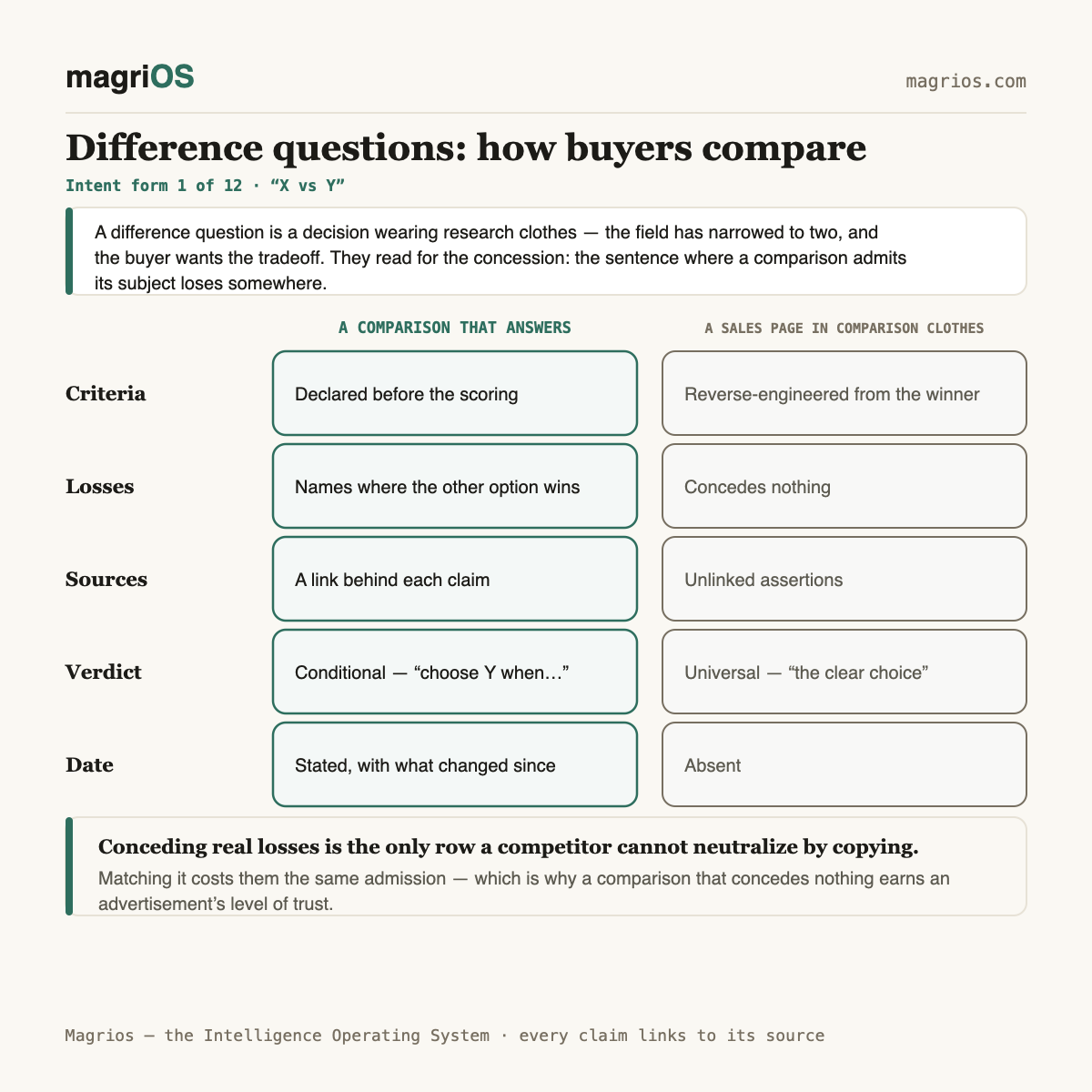
A difference question is a decision wearing research clothes. By the time a buyer asks "X vs Y", the field has already narrowed to two candidates, and what they want is the tradeoff — which option wins under their constraints, and what each choice costs them. Buyers compare by hunting for the concession: the sentence where a comparison admits its subject loses somewhere. A vendor who responds with two feature lists and a home-team verdict has answered a different question than the one asked.
What is the buyer actually asking?
Not for retrieval — for judgment. Feature pages the buyer can read without help; a difference question outsources the weighing. The buyer holds constraints (budget, team, timeline, appetite for setup work) and wants to know which side of the comparison those constraints favor. It is typically the second-to-last question in a purchase: the last is a decision question — "should we" — and difference is where the buyer arms it. Answering the retrieval half while dodging the judgment half is the standard vendor move, and buyers have long since learned to read past it.
Why does our classifier match difference before anything else?
In the intent classifier that routes questions through the Magrios knowledge factory, difference is the first of twelve patterns tested, and the position is deliberate: "what is the difference between X and Y" opens with the words "what is", so a definition pattern tested earlier would swallow every comparison in the corpus. The surface grammar of comparison impersonates definition. That technical detail mirrors a buying reality — comparison intent hides inside innocent wording, and a vendor who takes the wording literally, responding with tidy definitions of X and of Y, has missed the question entirely. The twelve-shapes overview maps where difference sits among its neighbors.
What evidence honestly answers X vs Y?
The test is whether the page gives the buyer real grounds to decide against you.
| A comparison that answers | A sales page in comparison clothes | |
|---|---|---|
| Criteria | Declared before the scoring | Reverse-engineered from the winner |
| Losses | Names where the other option wins | Concedes nothing |
| Sources | A link behind each claim | Unlinked assertions |
| Verdict | Conditional: "choose Y when…" | Universal: "the clear choice" |
| Date | Stated, with what changed since | Absent |
We hold our own published vendor comparison to the left column, including the part where it states what the other product genuinely does better. A comparison that concedes nothing reads as an advertisement and earns an advertisement's level of trust — from buyers first, and, we suspect, from everything downstream of buyers.
Why would comparison pages attract AI citations?
Split the claim by confidence before repeating it. Measured: which public pages rank for a difference-form buyer question is observable, scan by scan. Hypothesis, and labeled as one: an assistant asked "X vs Y" needs side-by-side substance to compose an answer, and a page already structured criterion-by-criterion is the closest raw material — so comparison pages are well-positioned sources for this form. What no outside party can verify is the selection step inside a model, and how AI assistants choose their sources keeps that boundary explicit. One related effect needs no model internals at all: a comparison hosted by one of its own subjects carries a discount. Human readers apply it consciously, which is the standing case for third-party corroboration over own-site claims.
How should a vendor write the X-vs-Y page — and how not?
Write the version you could forward, unedited, to a buyer who ends up choosing the competitor. Concretely: declare the criteria first; score both sides with a source behind each cell; name the buyer profiles that should pick the other option; date the page and revise it when either product materially changes. Do not publish a comparison whose conclusion was fixed before the evidence was gathered — the format makes that visible faster than any other content type, because the reader arrives holding the exact question your spin is dodging. There is also a durability argument. Of the five rows in the table above, conceding real losses is the only one a competitor cannot neutralize by copying, since matching it costs them the same admission. Buyers who have not yet narrowed to two are asking a different form — selection, where the shortlist itself is still being built.