Decision questions: how buyers finally commit
Guide · Frameworks · 4 min read · last verified 2026-08-11
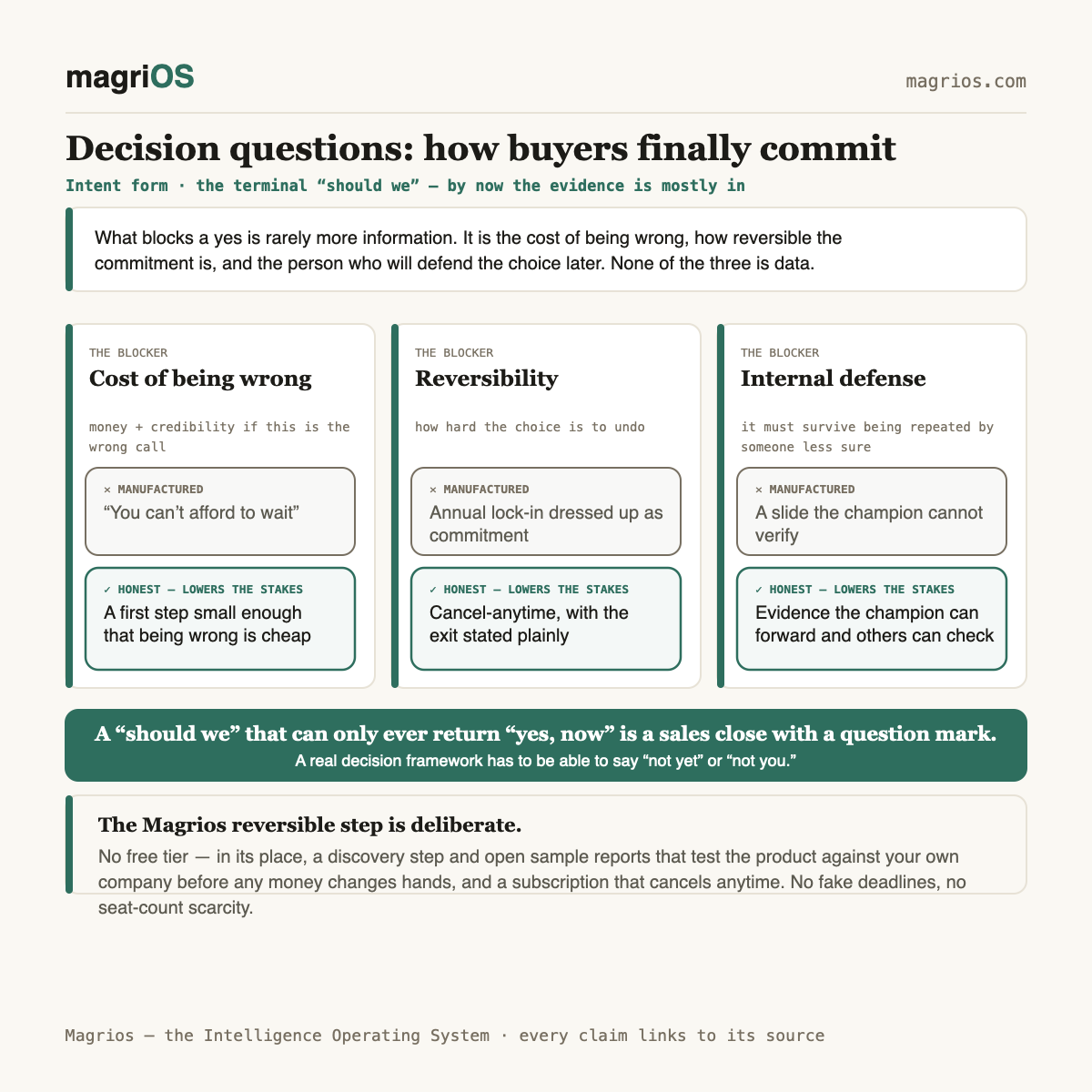
A decision question — "should we do this," "is it worth it," "do we need this" — is the last question a buyer asks, and by the time they ask it the evidence is mostly in. What blocks a yes is rarely more information; it is the cost of being wrong, how reversible the commitment is, and the person who will have to defend the choice later. The honest way to answer is to lower the stakes of the first commitment, name the buyers who should say no, and never manufacture the urgency a buyer can feel you inventing.
What has already happened by the time a buyer asks "should we"?
The research. A decision question sits at the end of a sequence — the buyer has mapped what exists, narrowed the field, and weighed the final two — so "should we" is not a request to begin evaluating. It is the buyer standing at the edge of a commitment they have mostly justified. The comparison is where they built the case; the decision is where they either act on it or find the reason they cannot. That reason is almost never a missing fact. It is a missing way to be wrong safely.
What actually blocks the commitment?
Three things, none of them data. The cost of being wrong — what the buyer forfeits in money and credibility if this turns out to be the wrong call. Reversibility — how hard the choice is to undo, because an easily reversed decision needs far less certainty than a locked-in one. And the internal defense — the buyer is rarely the only decider, so they need an answer that survives being repeated by someone less convinced than they are. A vendor who keeps stacking evidence is answering a question the buyer already closed, while the real blocker — how do I do this without betting too much — goes untouched.
How does a vendor lower the cost of a yes?
By making the first commitment small and genuinely reversible.
| The blocker | The manufactured answer | The honest answer |
|---|---|---|
| Cost of being wrong | "You can't afford to wait" | A first step small enough that being wrong is cheap |
| Reversibility | Annual lock-in dressed up as commitment | Cancel-anytime, with the exit stated plainly |
| Urgency | An invented deadline or vanishing seats | The real cost of delay if there is one, silence if there isn't |
| Internal defense | A slide the champion cannot verify | Evidence the champion can forward and others can check |
At Magrios the small, reversible step is deliberate. There is no free tier; what stands in its place is a discovery step and open sample reports that let a buyer test the product against their own company before any money changes hands, and a subscription that cancels anytime with its terms in plain view. We publish no fake deadlines and run no seat-count scarcity, because urgency a buyer catches you inventing turns the question from "should we buy" into "should we trust them."
When is the honest answer "not yet" or "not you"?
Often enough that a vendor without those answers is not answering decision questions — they are closing. A real decision framework has to be able to return no. Some buyers asking "should we" are buyers for whom the timing is wrong or the fit is thin, and a vendor who can say so keeps the buyers for whom the yes is genuine. The disqualifiers belong in the open: the profiles this is wrong for, the conditions under which waiting is correct, the adjacent problem another tool solves better. A "should we" that can only ever return "yes, now" is not a decision aid; it is a sales close with a question mark bolted on, and buyers price it accordingly.
How should a vendor answer the final question — and how not?
Give the buyer the smallest honest yes and the clearest possible no. Concretely: offer a first commitment whose downside is bounded, state the reversal terms before being asked, name the conditions that should make this particular buyer wait, and hand the champion evidence they can forward rather than a claim they must vouch for. Then stop selling — a buyer at the decision stage is reassured by a vendor visibly willing to lose the deal to the buyer's own judgment. At the answer-engine layer the advice is unchanged, though the evidence shifts. The roster of public pages behind a "should we buy" question is observable and re-checkable run to run; what makes an assistant quote one of them over a rival is not visible from outside, so our reading of it is labeled a hypothesis and left there. A decision question is the terminal shape among the twelve — every earlier form was the buyer gathering what they needed to answer this one, and the yes, once given, turns straight into a question of when to start. Answer it the way you would want to be answered when the choice, and the blame, are yours: the procurement desk that finalizes the purchase will test the same reversibility you either disclosed or hid.